Picnic with Brother Bandits

(O Seraphic Father St. Francis; long has it been since I have spoken of you and your ways: forgive me.) Here is a story of conversion and penance.

How St. Francis and his 'lesser brethren' (the friars minor) won the souls of bandits by humility and charity [Mirror of Perfection - #66].

A party of bandits who used to hide in the woods and rob travelers occasionally came for food to a hermitage of the friars situated above Borgo San Sepolcro. Some friars said that it was not right to give them alms, while others did so out of compassion and urged them to repent. Meanwhile blessed Francis came to this friary, and the brothers asked him whether it was right to give them alms.

The eternal debate: Who is my neighbor? Are the criminal poor entitled to compassion? Are they suitable candidates for repentance? Some say 'yes': others complain. Enter the Poverello; what does he have to offer? He counsels kindness and compassion for the conversion of bandits: while supplying spiritual guidance for his 'lesser brethren', a path for their sanctification.

And he said to them, 'If you will do as I tell you, I trust in God that he shall win their souls. So go and bring some good bread and wine, and take it to the woods where they live. And shout to them saying, "Brother Bandits, come to us. We are friars, and are bringing you some good bread and wine!" And they will come at once. Then you must spread a cloth on the ground, place the bread and wine on it, and serve them humbly and gladly until they have eaten.

The divine absurdity: Feed the thieves; serve them gladly and with great humility. Doesn't this resemble our Lords own action? Let the cloth cover the ground as the linen covers the altar: offer good bread and wine to them.

After the meal speak to them of our Lord's words, and end by asking them for the love of God to grant your first request, which is to promise not to strike or injure anyone. For if you ask for everything at once, they will not listen to you; but because you are humble and loving they will promise this immediately.

Can this really work, Brother Francis? Will love open their twisted hearts? 'Yes of course, each time they hurt others they do more harm to themselves, though they don't see it.' 'Give them God's words – let the Holy Spirit counsel them through you.' 'You yourselves, my brothers are to be God's Word.' 'They won't see or hear their Savior and Lord Jesus, unless you carry Him within you.'

On a later day take them eggs and cheese with the bread and wine to show that you appreciate their promise, and serve them until they have eaten. And after the meal say to them, "Why do you stay here all day to die of hunger, and suffer so much hardship? And why do you do so many evil things for which you will lose your souls unless you turn to God? It is better to serve God, for He will both supply your bodily needs in this world, and save your souls at the last." Then God will move them to repentance because of the humility and charity that you have shown them.'

'We did as you said Father Francis and we ourselves were filled with the Holy Spirit.' 'When they saw that we came back with food again, and were joyful in being with them, they were moved and amazed.' 'Not only that, but they realized the foolishness of their old ways and asked if they could have our joy.'

So the friars did everything that blessed Francis had told them, and by the grace and mercy of God the bandits listened to them, and punctiliously observed all that the friars had humbly asked of them. Further, because of the friars' humility and friendship towards them, they themselves humbly began to serve the friars and carried logs up to the hermitage on their shoulders for them. At length some of the bandits entered the Order; the others confessed their crimes and did penance for their sins, laying their hands in those of the friars, and promising that henceforward they would live by their own labor and never do such things again.

They confessed and did penance. Eight hundred years have passed and those with the spirit of St. Francis continue to call out: "Brother Bandits, come to us. We are friars, and are bringing you some good bread and wine!"

Faith Precedes Wisdom: It’s a Spiritual 'Law'

How interesting is today's set of readings from the Lectionary. We have just witnessed all the drama of the Easter season, and its culmination in the outpouring of God's Spirit in superabundance on the Apostles. On the very first day back in Ordinary time we hear a message insisting on 'faith' as a precursor for wisdom, and we see the Lord Jesus shaking his head asking 'Why is this generation looking for signs?'

Today's gospel reading is actually a confrontation between the Pharisees and Jesus: they argue and they want to test him. They are what we would call 'Religious Scientists' who want to observe and evaluate the data. 'Just show us a sign; prove who you are and we'll listen to your theory'. In one sense, none of this is unreasonable as we note that the Lord did perform many signs and wonders during his period of proclaiming the kingdom. And the signs were seen and recorded, and the wonders were witnessed and pondered.

Today's first reading from the Letter of James points to a vital sequence in spiritual growth that often gets ignored in practice. Faith precedes wisdom. James puts it this way:

"But if any of you lacks wisdom, he should ask God who gives to all generously and ungrudgingly, and he will be given it. But he should ask in faith, not doubting, for the one who doubts is like a wave of the sea that is driven and tossed about by the wind. For that person must not suppose that he will receive anything from the Lord, since he is a man of two minds, unstable in all his ways." [James 1:1-11]

Those who accept the Faith in its most rudimentary outlines often move forth slowly in devotion and understanding because they allow unanswered questions to halt their progress. Even those who simply must have their questions answer as a precondition for faith would argue that 'we are begging the real questions' that lurk as barriers to their faith: 'Give us the 'ah-hah' moment of realization and then we'll believe'. Skeptics take note: I don't deny the reality of 'ah-hah' moments, but they are always proceeded by humility and faith. Neither do I deny the real difficulties that unanswered questions pose: and yet ironically, it's the increase in faith that brings wisdom and understanding to unanswered questions and not the other way around. It's a 'spiritual law' that must be respected.

If I wanted to learn the science of physics, I would enter a science class and listen to a physics professor. If I were highly astute I might discern 'gravity' on my own or pick it up from casual conversation and believe in its effect. But to go beyond I would actually require some humility and faith as I would have to sit at the feet of those who are trained in the science. I would have to listen and have my knowledge guided even to the point of conducting 'experiments' that have been produced and reproduce thousands of time in order for me to observe the predictable results. And it almost goes without saying that to learn physics I would speak with a physics professor, not a voodoo doctor.

Let me insert here that I don't need to study physics to enjoy its benefits. And I don't need a PhD in order to avoid jumping off a cliff foolishly; nevertheless whether knowingly or unknowingly, I must respect the law of gravity.

As implausible as this might sound, there's something akin to that in the growth of a faith relationship with God. We follow Church teachings and listen to the 'professors'. In the realm of faith we call them 'shepherds, bishops and pastors' as opposed to professors but their role is similar. We review life's data with the discerning eye of faith formators; who are simply people who have walked ahead of us on the faith journey. We ask the help of those who can demonstrate some acumen in their life of faith and in this process; faith is passed on and grows. We avoid serious pitfalls and believe it or not, we obtain the desired results.

My analogy is limited for certain, but in each case we must demonstrate faith and humility as a precondition, before we can even attempt to acquire the knowledge that we seek. (Here's some practical advice from a former athiest who confronted this very issue.) If you ponder it sufficiently you'll see that it not such an unreasonable demand. And that's exactly what the Pharisees in today's gospel were unwilling to do.

Eucharistic Adoration Documentary

A woman and her husband have created and produced a new documentary on Perpetual Eucharistic Adoration which is titled "Watch With Me". I was highly impressed with the preview and wanted to recommend it to the blogging community. Here's the post where the trailer video is embedded. View it and see for yourself.

Act When You Are Acted Upon

Novena to the Holy Spirit (Introduction+Nine Days)

Day Nine-Saturday of the 7th week of Easter

[Note: I've included an epilogue or personal testimony at the end of the Novena

Let me recall from Day One's opening scripture passage: The Spirit helps us in our weakness, for we do not know how to pray as we ought; but the Spirit himself makes intercession for us with groanings that cannot be expressed in speech. He who searches hearts knows what the Spirit means, for the Spirit intercedes for the saints as God himself wills. [Romans 8:26-27]

I interpreted that passage this way: "The Holy Spirit knows us in a way that words can't express; knows us in the way of God; and the Father knowing us in this manner, acts according to His own Will."

Let me offer on the final day of the Novena, this passage: Similarly, no one knows what lies at the depths of God but the Spirit of God. This Spirit we have received is not the world's spirit but God's Spirit, helping us to recognize the gifts he has given us.[cf. 1 Cor. 2:10-12]

This brings us full circle. The Father knows us because the Holy Spirit penetrates our being and 'groans' (intercedes for us) to the Father on our behalf. The same Holy Spirit knows the depths of God and provides 'gifts' to his children, according to our Father's holy will. Our understanding of this connection between God and us via the Holy Spirit has the potential to alter our awareness of how God is acting in our life. In a sense, if we could 'eavesdrop on this divine conversation' of the Spirit pleading on our behalf as our advocate; and hear the Father's response with his good gifts; then we would come away with a heightened sense of what our prayer life should be. The 'wavelength' of our own personal prayer would begin to look identical to the Spirit's signal. Once we see that God is acting in ways we've missed (or even resisted), we can try to discern his actions with more clarity and sensitivity.

I trust that those who have made it to this final day are prepared to receive the gifts and even more desirous to use the gifts. To all those looking for inspiration and companionship on our little pilgrimage of prayer, I am confident that the Holy Spirit will not fail us. We may receive our gifts with a fanfare or we may receive them with quiet gentleness. We may only discover these gifts some time in the future as their effect begins to manifest noticeable changes in our lives. Don't be afraid to revisit this prayer anytime during the year. I myself pick up the Novena whenever I sense I need a lift; so come back anytime to re-read these simple reflections, if they help. Peace and all good.

Come Holy Spirit; fill the hearts of your faithful people. Enkindle in us the fire of your divine love.

-------------------------------------------------

Epilogue (sort of) or a personal testimony:

My regular readers know by now that I very seldom speak of my personal experience. This blog has always been a place for me to record and journal spiritual reflections and it contains very little of a 'diary' like quality. But here I do want to share a personal testimony about my experience with the Holy Spirit.

I am a 'cradle' Catholic and I enjoyed the life of the Church as every young person should. My mom (a single parent) had me baptized as an infant and when I was ready for pre-school even dropped me off at Catholic 'nursery' school. Each morning a waiting nun showed her dedication by virtue of arriving early to accommodate mom's factory schedule. We attended Mass together regularly through my youth but as I became older some 'event' caused my mother to send me on alone . When the time came to make my Confirmation at around the age of thirteen, I attended all of the catechism classes as required and was fully prepared to be confirmed. We, 'the candidates', were measured for our robes and anxiously awaiting the ceremony.

A new pastor was transferred to the parish, who my mother knew well and had a 'difficult' time with because of a separate family issue. The fact is that my grandfather (her dad) had committed suicide and this priest (acting within the norms of the Church at that time – the late 1950's) refused to provide a funeral service. After some contention I believe he did receive 'some sort of service' by another priest, but was not buried in a Catholic cemetery. I believe that was the 'event' that withered her desire for regular Mass attendance, but she was insistent that I attend even through I had some lazy Sunday mornings. (In her later years she did attend mass regularly and even enjoyed daily mass on television when she became frail.)

At any rate, this same pastor was assigned to this parish and noted that I actually did not 'belong' to that specific parish and thus could not make my Confirmation there and then. He was correct; I did technically belong to a parish a few blocks away. Back in those days we were required to register to a parish based upon our street address; that determined where one 'belonged to'. But I also belonged to a Boy Scout troop associated with my 'alien' parish and thus began my confirmation studies with all my friends who were enrolled in the same school and activities as I was. The original pastor had no problem with this.

This 'grudge' between my mother and the pastor was given 'new food to chew' and he would only allow me to be confirmed at his parish if Mom could arrange for a 'letter from the Bishop or my rightful pastor'. She tried frantically, but as it was so short a time involved - it simply didn't come to pass. So the time for the Sacrament came and went, and I was not Confirmed. I scarcely remember my own reaction; I believe I was disappointed but not bitter. I certainly was not disposed to start classes again and so my meeting with the Holy Spirit was delayed. Unconcerned, I continued to attend church faithfully until sometime after I began to attend college.

College in 1969 was quite an interesting transition to independent living. I began on the right path by attending Mass regularly at the university chapel. So what was it that caused me to fall away for a dozen years or so? More than likely it was the period of 'great loosening of cultural moorings'; meaning an unpopular war, and a heightened resistance to authority, including the authority of the Church. It was a time for 'going with the flow' and it was a time for searching into new thoughts and Eastern Mysticism and 'expanding our minds' both natural and otherwise. There's no sense filling in the details…use your imagination. Some of this is cause and some is effect. I never felt alienated from God or angry, it was simply a sense that organized religion was too restrictive and controlling: and what about all the other people in the world who never heard this message of evangelization?

But by age thirty-two, I had eventually graduated college and was now in my first marriage with a son of around three years old, and more than a dozen years lapsed from the Faith. Entering stage right, my Mother came to visit our home for Easter weekend and simply asked to take my son along with her to Easter celebration (think 'gift of counsel' as in letting the Holy Spirit take over). For some amazing reason, I blurted out that I wanted to go also. To this day I can only thank the Holy Spirit for catching me in such an unguarded moment. And so we went and after my first reunion with the Mass I knew instantly that I was 'caught in the trap'.

I had the good sense to avoid Holy Communion and began to attend for a few weeks on my own and somewhere in the Easter season I decided to see the pastor and talk things out and go to confession. (I know this is getting a little long but stick it out).

While all of this was happening I had become friends with a new co-worker, who was a man of faith, but not overly pious. He helped me out with some 'Church' issues and gently insisted that confirmation was the next step. Right around this time we received some devastating news; he was diagnosed with brain cancer. He was a bit older than me but still in otherwise good health at age 50.

We began to pray for healing and in doing so we reached out to people who were truly devout and walking in the ways of the Lord. We visited the home of one poor elderly widow, who I was told, had a 'bleeding stature of St. Theresa of Liseux'. I saw the small statue of pewter with dried blood but never saw a bleeding event. But the bleeding mystery became moot as the genuine Christian love and concern of the widow and her companions for desperate pilgrims spoke more powerfully than any statue could. These were the earthly communion of saints who filled this holy widow's home - who truly believed in the love of God - and they prayed for my friend – and they prayed for me.

Meanwhile, my new pastor and I connected and he discerned me well. He knew I had already attended my classes decades before; so we had a few hours of discussion about the Catholic faith and after some individual sessions with him as teacher, I was deemed prepared to make my confirmation along with the parish youth. My friend with the brain cancer agreed to be my sponsor.

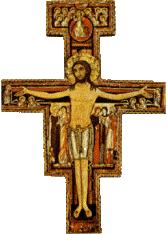
As the time to be confirmed arrived, my friend was undergoing some serious medical treatments. The day arrived and we walked into the Church together. He had lost all his hair due to radiation and there were grid lines drawn on his head to mark where the technician should aim their treatments. He had never seen the inside of this church and when we sat down in our designated pew he was quite taken by the size and 'beauty' of the crucifix that was on display. He was absorbed in its presence and I believe that he came to know, then and there, that the physical healing he hoped for was not for him. I can specifically remember his raising his eyes in adoration and remarking how totally comforted he was by this fourteen foot image of Christ on the cross. This picture is that very crucifix.

Finally, it was our turn to approach the visiting Bishop and my friend placed his hand on my shoulder and presented me for the Sacrament. It was done. Fortunately for me the Holy Spirit allowed me the time to make it back to the pew: from that moment on I was 'slain in the spirit' although I didn't know what that meant at that time. It was 'the sweet anointing from above' and I will never forget the intense love of God washing over my entire being as I sat paralyzed for quite some time. When others rose I simply could not move.

That was twenty-three years ago. My friend died that year - several years younger than I am today.

What I take most from all of this is that the Holy Spirit does what he wills, when he knows we are ready. It's my belief that he kept his gift for me at age thirteen in reserve, and gave me an overly generous portion of Himself at my later age for some mysterious reason. Perhaps I wasn't suitably disposed at age thirteen or he had bigger and differing plans that defy the normal sequence of events. I simply don't fret about mistakes of the past or spiritual gifts I may have squandered. I'm confident all of that has been forgiven. What I am concerned with is my response today. It's quite true that one moment of grace and one drop of divine blood is all we need.

The other thing I've learned to appreciate is that when it comes to the Spirit, we must become very docile, and learn to quickly respond. We must act when we are acted upon. The book called Acts of the Apostles is sometimes referred to as 'the fifth gospel' or the 'Gospel of the Holy Spirit'. It really does focus on actions. It focuses on the response of all Christ's disciples to receiving the Holy Spirit and his guidance. And so must we. I invited those who's faith was lukewarm to participate with the hope of activating the graces that were genuinely imparted by your Bishop, perhaps many years ago. And for the unconfirmed; even unbaptized 'seeker', we have prayed for you to experience, at the very minimum, some rudimentary awakening that would help you in your spiritual journey. No matter who you are, the Spirit brought you here NOW (even those who read this months later) to receive some portion of his gifts if you will simply desire them and remain open.

This online Novena came about not because of my own desire, but because I felt a quiet and simple inspiration, which I acted upon. I have completed my task and leave the end result to God.

The Gift of Wisdom

Novena to the Holy Spirit (Introduction+Nine Days)

Day Eight-Friday of the 7th week of Easter

Is there anyone among you who is wise and understanding? He is to prove it by his good life, by his good deeds performed with humility and wisdom. But if in your heart you are jealous, bitter, and selfish, don't sin against the truth by boasting of your wisdom. Such wisdom does not come down from heaven; it belongs to the world, it is unspiritual, it is demonic. Where there is jealousy and selfishness, there is also disorder and every kind of evil. But the wisdom from above is pure first of all; it is also peaceful, gentle and friendly; it is full of compassion and produces a harvest of good deeds; it is free from prejudice and hypocrisy. And goodness is the harvest that is produced from the seeds the peacemakers plant in peace. [James 3:13-18]

I would say St. James is cutting with the proverbial 'two-edged sword'. The scripture quote above is both a stern admonition and a heavenly lullaby. There's enough meat in this passage to carry us to the end of our discussion of the 'seven gifts'.

Seeing the admonition portion of this passage makes me realize some things I should have said at the very beginning. To behave as a guide through this Novena and to make some unstrained or murky spiritual comments is cause for a little 'fear and trembling'. My only recourse is that I did pray every day for guidance and asked to be protected from saying anything too far fetched. My overall purpose was to help anyone who was looking for some spiritual companionship, to move close enough to these 'gifts of the Spirit', so that they could feel their spiritual attraction and draw nearer.

Then there's the issue of my being a follower of St. Francis: he was concerned of limiting the spiritual life to a speculative discussion of spiritual matters. I believe it was he who said, "I would rather feel compunction, than study its definition." Likewise I would rather experience 'pure wisdom from above' quietly, even in ignorance, than 'sin against the truth by boasting of wisdom.' (St. Francis - pray for us.)

To live under the influence of heavenly wisdom has the effect of placing us 'in the light of the Lord'. For the Christian the 'gift of wisdom from above' causes us to base our lives on eternal values. Our motives and goals are all enclosed within a heavenly design: the rewards of this life soon become rusty and eaten by moths; empty of their allurement. The gift of wisdom from above makes us ever connected to eternal assistance and indifferent to earthly esteem and power sources.

Wisdom is not a spiritual PhD. It is not an award for theological rigor or memorized scripture passages. Rather it is the unseen vision of what it is that pleases God. Wisdom is a gift of 'spiritual bifocals' given as heavenly assistance to keep us clearly focused on both our earthy pilgrimage and our eternal home.

Using our gifts of knowledge, understanding and council (as discernment) we should be able to distinguish between this worldly and heavenly wisdom. If we could somehow remember to review the passage above, on a periodic basis, that should go a long way toward keeping us correctly aligned.

Some Christians tend to misread the Letter of James; claiming that the author is somehow disparaging faith and overemphasizing the value of works. Not so at all. I love this letter as it is the 'wisdom' letter of the New Testament. Its verses are full of practical guidance regarding living an authentic Christian life. 'If anyone wants wisdom he should pray for it', says the Letter of James [Jas 1:5]… (and read the Letter of James often and slowly, says Tausign.)

Tomorrow: Day Nine - the wrap up and a personal testimony.

Reflection questions: Can you name instances where your worldview changed based on adopting eternal values? What values do you most cherish and why?

Come Holy Spirit; fill the hearts of your faithful people. Enkindle in us the fire of your divine love.

The Gift of Counsel

Novena to the Holy Spirit (Introduction+Nine Days)

Day Seven-Thursday of the 7th week of Easter

"When they hand you over, do not worry about how you are to speak or what you are to say; for what you are to say will be given to you at that time;" [Matt 10:19]

The 'gift of counsel' has a variety of meanings that are spoken of. First, it's the gift that assists and elevates the 'virtue of prudence'. Often it is referred to as the gift of 'right judgment'; as in choosing correctly or discernment God's Will. Finally, it's the gift of 'spiritual intuition'; meaning to respond as the Lord would have us do – quickly, in an unexpected or difficult situation. It's this latter meaning, as illustrated in the opening passage that I wish to dwell upon today.

In the very beginning I mentioned that to desire and receive these 'seven gifts' implies service to the Kingdom of God. Whether it is to witness or proclaim the Kingdom, this 'gift of counsel' is the gift of letting the Holy Spirit take control in a particular situation. Here's an example from scripture:

When they had made the prisoners [Peter and John] stand in their midst, they inquired, "By what power or by what name did you do this?" Then Peter, filled with the Holy Spirit, said [See full passage here - Acts 4:7-13] - when they saw the boldness of Peter and John and realized that they were uneducated and ordinary men, they were amazed and recognized them as companions of Jesus.

The apostolic prisoners relied on the Holy Spirit (they became 'filled with His Presence') to say what needed to be said in a bold fashion.

A more modern day and widely known example of this gift is seen in the witness of St. Maximilian Kolbe, the saint of Auschwitz. If you recall the story, Fr. Maximilian steps forth to take the place of a prisoner (one of ten) who was condemned to death as punishment for an escape attempt of another.

The ten were selected, including Franciszek Gajowniczek, imprisoned for helping the Polish Resistance. He couldn't help a cry of anguish. "My poor wife!" he sobbed. "My poor children! What will they do?" When he uttered this cry of dismay, Maximilian stepped silently forward, took off his cap, and stood before the commandant and said, "I am a Catholic priest. Let me take his place. I am old. He has a wife and children." [Read a brief but beautiful account here]

Here the humble friar, without forethought, allows the Holy Spirit to take control of the situation. It's a most extreme and dramatic example for sure, but it shows how the Holy Spirit will intercede when we are powerless and provide us with exactly what is needed right on the spot.

If we contemplate this 'gift' in a more mundane fashion we can see opportunities that pass in our lives where this gift is very useful. Perhaps it's that ability when caught off guard to say exactly the right thing in order to elevate a bad situation with grace. Or maybe it's the occasion of encountering someone with spiritual needs or a grudge, and allowing the Holy Spirit to guide our response.

The cultivation of this gift is not in filling ourselves with memorized responses, as in getting ready for a game of 'Spiritual Jeopardy'. Rather the advanced preparation is in emptying ourselves and aligning our hearts to God. It's in fostering the desire for God's Will to be done in every circumstance, and creating the awareness that the Holy Spirit genuinely desires to 'breathe forth' through us, if we will only give him the latitude. It means among other things, removing bitterness, hatred, cynicism, and other offensive behaviors that often jump to the fore and abort the gift of counsel before it can emerge. To pray for this gift will necessarily lead to a rethinking of our attitudes on 'confrontation', 'insistence on being right' and 'defending ourselves'.

Reflection questions: What behaviors must I change in order to allow the Holy Spirit to act more freely through me? Examine some situations in the past where you might have interfered with the Holy Spirit's grace in reaching others in need. Can you recall what specific action or behavior blocked this 'gift'?

Come Holy Spirit; fill the hearts of your faithful people. Enkindle in us the fire of your divine love.

The Gift of Understanding

Novena to the Holy Spirit (Introduction+Nine Days)

Day Six-Wednesday of the 7th week of Easter

A few days ago I remarked that the gift of Holy Fear has two aspects. First was the grasp of divine reality that 'God exists' (in his own words "I AM"); and that He is Good and Holy. The second or resulting gift was the desire not to offend God or injure our relationship. The connection between the two aspects is linked by the 'gift of understanding'.

In the last reflection we saw how Peter acquired the 'knowledge' of Jesus as the Messiah. He 'knows' but he doesn't yet 'understand' what that means. In fact, his actions from that point until Pentecost demonstrate this. Consider how he reacts to the Lord's arrest with his outburst of violence; his later panic, fear and threefold denial. Even his experience of the Risen Christ and his dialogue with him on the beach 'Do you love me Peter', 'Yes you know I love you Lord'. All of this is his 'continuing formation' which is culminated on the Feast of Pentecost and the descent of the Holy Spirit to 'rest' upon him and the others. NOW he understands. HERE is where he can say who Jesus really is and what he now must do.

Understanding is where 'knowledge' springs to life and leaps for joy. How often have we claimed to 'know' the Lord or some important 'truth of our Faith', but have done nothing to put that knowledge into action. 'Understanding' is the animating portion of 'knowledge': it is its 'soul'. Understanding not only enlightens our knowledge of positives: but negatives too. Sometimes the gift of understanding can bring remorse of the past or the call for drastic change: something called repentance. Knowledge of our sin can be sterile if we don't understand its meaning. When we've experienced 'a surge of guilt' regarding our sinful behavior then we have felt the presence of 'the gift of understanding'. But whatever the emotion involved, 'understanding' is a 'transformation' of a mere fact into a realization.

Let me insert a caveat: We can't run away from the duty to obey a commandment of God simply because we don't understand it. In fact, our faith might be strengthened as we carry on without a clear understanding. But in general, God will give us 'the gift of understanding' as it is required if we desire it and ask with humility.

We desire understanding when our previous grasp of knowledge or some 'Truth of our Faith' is challenged and seems inadequate. It could be a troubling passage of scripture that doesn't seem to make any sense or contradicts our current understanding. It could be a Church teaching that is quite well known but difficult to follow. We might grip our teeth and carry on with 'Fortitude' but the 'gift of understanding' will make any of our difficulties lighter.

As in all of these gifts, it's important to recall that they are being given to 'move the mission' of the Church. It's not about obtaining divine consolation as spiritual reward. Again that is for the next life. But this 'gift of understanding' is to help the 'soldier Christian' grow in maturity and enter into the task of evangelization.

Reflection questions: Can you recall a 'transforming experience' when something that you previously knew was 'true' now became animated with meaning? Can you name some articles of our Faith or some Church teachings that require greater understanding on your part?

Come Holy Spirit; fill the hearts of your faithful people. Enkindle in us the fire of your divine love.

The Gift of Knowledge

Novena to the Holy Spirit (Introduction+Nine Days)

Day Five-Tuesday of the 7th week of Easter

When the disciples got near him, they asked him. "Why do you speak to them in parables?" Jesus answered "To you has been given knowledge of the mysteries of the reign of God, but it has not been given to the others." [Matt 13:10-11]

I find this passage quite intriguing about 'knowledge' as one of the 'gifts' of the Holy Spirit. We see that we are speaking of knowledge as 'revelation' in this case. Revelation unfolds a 'mystery' that goes beyond our intellect. It is 'given' by someone. It is 'received' by some and not all.

To the 'seeker' this scriptural passage alone might open up a locked gate behind which lies untold treasure. To accept this statement of Jesus on its face value, it seems to me, breaks down many of the barriers to acquiring true faith; and faith is the essential virtue needed for life with God. If this scriptural passage is taken as 'true' (and therefore worthy of pursuit); then knowledge of the mysteries of God, doesn't require endless searching and effort. Instead it requires the humility to accept a 'free gift'. The root meaning of humility comes from the term 'humus' as in 'the quality or matter which enriches soil'.

The actual parable that prompted the question to Jesus, 'Why do you speak to them in parables?' was the story of 'the farmer who sows seed' [Matt 13:1-9]. The farmer is God who scatters seed everywhere, not just where its growth is most probable. (As Christians we must trust that the divine seed is in everyone). Because of the various soil conditions that 'receive' the seed; it either flourishes, or it doesn't. In this sense, each and every person has a spiritual plot of fallow (unplanted) land with the responsibility to cultivate his/her own life's circumstance; and prepare themselves to receive God's message and his graces. This parable implies that even without supernatural aid the very 'natural law' written upon our hearts dispose us to lead a good life. This good life is characterized by true humility (humus), and thus, can receive 'knowledge' (revelation of God and his Kingdom) as a 'free gift'.

If you read Jesus' explanation as to why he uses parables [see Matt 13:13-23] then you discover that they are an attempt to communicate with those who 'Look - but do not see', 'Listen - but do not hear'. We can take that to mean that they are not truly disposed (as 'humus', good soil) to receive revelation, but rather are 'hard of heart' or 'choked off with weeds', etc.. Not having the proper soil bed they need, they 'look and listen' - fruitlessly.

The clearest example of receiving 'knowledge' as 'free gift' versus logical conclusion is when Peter answers the question of Jesus: 'Who do you say I am?' 'You are the Messiah', replies Peter. At which Jesus says, "Blest are you Peter…No mere man has revealed this to you, but my heavenly Father." [see Matt 16:15-17] Peter may not be the perfect example of true humility, but he is 'humble enough' (meaning his life's soil is fertile enough) to receive the revelation of God.

Can you see the vital connection between 'humility' and 'knowledge'? I'm not speaking of humility as a personality trait, but a healthy spiritual soil bed waiting to support and nourish revelation. For me at least, I experience 'knowledge as gift' when I least expect it: when I have not been looking for a 'Truth'. If I experience deeper insight into a matter that is already known to me; then I would call that 'understanding', our next 'gift'.

Prayer for today: Lord Jesus, today for the first time I open my heart with humility to enrich the seed bed of my soul. Please plant the seeds of knowledge (or ask for another spiritual gift that you desire_______) here and now.

Reflection Question: Are we disposed to receive the 'seeds of knowledge of the kingdom of God' and allow them to flourish? What specific steps could we take to 'enrich our life's soil', to give it a more 'humus' like quality? (i.e. increase prayer time, decrease anxieties, etc.)

Come Holy Spirit; fill the hearts of your faithful people. Enkindle in us the fire of your divine love.

The Gift of Fortitude

Novena to the Holy Spirit (Introduction+Nine Days)

Day Four – Monday of the 7th week of Easter

Fortitude (or Courage as it's sometimes called) is a gift that gives us strength and endurance in a painful or difficult circumstance. Again it's in that grouping of the 'gifts of the heart' along with Holy Fear and Piety. Fortitude assists Piety when we struggle with our duty of worship.

Fortitude as a spiritual gift provides assistance in following the ways of the Lord. It's not the gift of strength alone, but strength in those particular circumstances that call us to witness to God. There are other forces that drive us also into action that have nothing to do with the spiritual gift of fortitude. Think of panic and fear as an aid to self preservation. Think of our ability to stampede over others and their rights in order to make our lives easy or safe. These forces have power and impulse like fortitude but are not guided in the ways of the Lord.

Fortitude helps us to bear our own weaknesses with grace, as we await our own conversion. Yes it can be a burden to have to endure our own lack of patience, or charity. And when we come to realize that we have to bear our own weaknesses, then we can also do better with bearing the weaknesses of others. Humiliations born of malice become transformative into spiritual profit with the help of Fortitude. Fortitude helps us to bear persecution, natural or spiritual. We can stand in the breech against ridicule or slander.

For reasons beyond the scope of this reflection, we as followers of Christ will always be confronted with persecutions and hardships [see these passages]. "Blessed are those who are persecuted for righteousness sake, for theirs is the Kingdom of heaven." : this is one of the beatitudes and a truism of our Faith. Sadly this truism is sometimes stood on its head, as we seek to escape persecution, and worse, attack others in the name of 'defending ourselves or our Faith.' But the Lord says differently, [Matt 5:39-48] instructing us to 'Love our enemies and pray for those who persecute us'. Thus our ability to practice the Christian virtue of Love often needs strength and courage: 'the gift of fortitude'.

I would say that endurance in tribulation (born in the manner that Christ himself preached and lived) is far more powerful than any other manner to convey the message of the Gospel. The Gospel stands in contradiction to the 'way of the world' the 'easy way'. While we seek to 'transform' our world with the gospel message, the reality is that we will never be able to embrace worldly values that overlook the gospel message of eternal life. This is one of the reasons why the world will forever persecute us. In this realization, the 'gift of fortitude' will always be our indispensable ally on our spiritual journey.

Fortitude is intimately linked with the theological virtues of faith, hope and love; as these must not only be 'declared', but put into lifelong practice, often in very difficult circumstances, even persecutions. True Christian fortitude endures this: even embraces it heroically unto death if necessary, and transforms the sting of persecution with the power of love and pardon of neighbor. In doing so, the true Christian message shines like an light that penetrates far beyond Christian rhetoric, logic and reason.

All of this talk of persecution can make us feel overwhelmed with sticking to the gospel message. To speak of the 'gift of fortitude' reminds us of something very unpleasant: spiritual battle and trial. But just as fortitude is a helper with genuine Christian love; so too should we remember that 'perfect love casts out fear' [see full passage here, 1 John 4:13-5:2] and provides a reason to desire fortitude. One of the techniques we're taught to handle natural fear is to take a deep breath. Likewise, in the spiritual realm we might try taking a 'deep spiritual breath filled with the Holy Spirit' and praying to God: "Lord please send the Spirit of Fortitude."

Reflection question: How might we develop and exercise this 'gift of fortitude' as a muscle?

Come Holy Spirit; fill the hearts of your faithful people. Enkindle in us the fire of your divine love.

The Gift of Piety

Novena to the Holy Spirit (Introduction+Nine Days)

[Note: Since the introductory remarks to this Novena I've witnessed quite a few 'hits' but no comments. I would certainly love to here if the Holy Spirit is whispering anything in your ears.]

Day Three – 7th Sunday of Easter

I used to regard 'the gift of piety' as a reward or an outcome of my relationship with God, especially when things were going well. If that were actually so, 'piety' would not have been titled a 'gift', but rather one of the 'fruits' of the Holy Spirits…love, joy, peace, etc. [cf. Gal 5:19-26]. Let's remember that these gifts are meant to assist us, not serve as consolation.

I may experience feelings of love, peace, and joy as I serve and worship God…or I may not, especially when true sacrifices are called for. Piety is often referred to as the gift of making the 'bitter turn sweet'; especially when it comes to matters of worship and devotion towards the Church. To obey God: to surrender our wills to His Holy Will is anything but 'sweet' (at least in the beginning). To do so even when it is hardship and pain is my understanding of the meaning of Piety as a gift of assistance. Piety is best displayed by Jesus and Mary in The Passion.

Piety is the gift of steadfast desire to keep in contact with God through thick and thin. If we continually move towards God because of our needs, and become lazy when we're satisfied; then we are experiencing a lack of Piety.

Some spiritual writers have divided the 'seven gifts' into two categories: those involving the heart (Holy Fear, Piety, Fortitude) and those involving the mind (Knowledge, Understanding, Counsel, Wisdom). In this sense Piety is directed to the heart. It falls in between Holy Fear (as giving honor and obedience to the Father) and Fortitude (which is perseverance and a gathering of spiritual strength).

This seems like a good place to bring up the issue of worshiping God as a people. Again for those who are not practicing faith in a community of believers, you are missing out on one of the vital elements that must be in place for the Christian. Staying home and reading the bible or climbing a mountain to experience peace, as wonderful as they are, is simply not a substitute to worshiping and serving God in community. Most people who have 'fallen away' and later returned can attest to this. I mentioned in an earlier reflection that we can have our 'gifts' dry up or even have them 'withdrawn' simply because we are not approaching God in community. To approach him alone is a most serious disadvantage.

"Again, truly I tell you, if two of you join your voices together on earth to pray for anything whatever, it will be done for you by my Father in heaven. For where two or three are gathered in my name, I am there among them." [Matthew 18:19-20]

Whatever obstacles or barriers keep you from worshiping together with the people of God must be overcome; and they are ultimately overcome with 'the gift of piety'. So ask for this 'gift', in particular.

Reflection questions: Do we take the 'gift of the Church' for granted or see it as optional? Are we prone to 'going it alone' with God? What are practical ways that we can stir up this gift of piety: in ourselves, our children, our spouses?

Come Holy Spirit; fill the hearts of your faithful people. Enkindle in us the fire of your divine love.