Showing posts with label Formation. Show all posts

The Saint and the Sultan


The Crusades, Islam, and Francis of Assisi's Mission of Peace

[A mixture of reflection and book review]

May the Lord give you peace.

It seems that the death of bin Laden has had a mixed effect on me, causing me to search for a real gospel approach to the problem of enmity and hatred. Through twists and turns I discovered the book The Saint and the Sultan by Professor Paul Moses. As soon as I entered its realm, I found myself open to its inspiration and nourished by its meaning. What I discovered was the 'sonorous voice of St. Francis' singing a neglected gospel canticle of peace and reconciliation to a world trapped in an unholy embrace of hostility and death.

The author is a journalist, not a historian, nevertheless he utilizes extensive travel and research into the life and times of St. Francis. The Seraphic Saint is revealed beyond the traditional sources through additional chronicles, journals, and documents. There are substantial notes and references, yet its very readable. The portrayal of St. Francis is very convincing, because we see him committed to the gospel in a way that signals his uncompromising belief in the transformative power of love and pardon. (see Article XIX, SFO Rule)

One of the goals of the book is to reignite Francis of Assisi's missionary vision of peace among peoples who are estranged.  To understand what Francis has to say we must first see his conversion in the context of his lived experiences, particularly his intimate contact with war; its bloodshed, imprisonment, and all the other demons that swirl around the battlefield. This perspective is what makes the book a success. It's into this wounded and tortured soul that the seeds of the gospel find their mortified soil.  Now the young Francis is sufficiently transformed to encounter the Savior in his vision.  From here he laucnches into a new life of penance and poverty with no restraint.

The Saint and the Sultan attempts to explain why the message of St. Francis (specifically regarding his attitude toward war) is clouded. According to the author, those attempting to convey the charism of Francis are caught in conflicting cross currents. Then as now, the first casualty of war is truth.  The aura of St. Francis had to pass through a Church mired in difficult circumstances. Even the rivalry within the early Franciscan Order plays some part in altering the sublime message.

Perhaps this 'cover up' is the most controversial claim of the book. Nevertheless, I chose to align with the stated goal of revealing St. Francis as the model of peacemaker in the highest order.  The radical expression of the gospel as shown in the life of Francis remains the more relevant message and overshadows the need to find a conspiracy. 

The Church of his time is in disarray, but we already knew this, since Christ himself spoke to the Poverello…'Francis, go and repair my Church, which you can see is falling into ruin'. The real and imagined heresies bred suspicion and anxiety and raised the specter of severe condemnation, even death to those taking opposing positions. Professor Moses reveals to his readers the historical scene and its relevant characters candidly, yet he meticulously sticks to his theme while sparing his readers a diatribe. This is one of the subtle lessons of the book.

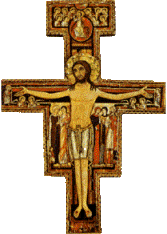
During the lifetime of Francis, the relic of the 'True Cross' accompanied the Crusaders into battle. Thus the Cross became both divine protection and weapon against the foe. One's standing with God was manifested in the winning or losing of the battle; but either way, the mission was deemed sacrosanct. While the worldly Francis would have applauded this, the penitent Francis came to see through it with a more penetrating vision.

For Francis in his journey, the 'True Cross' remains a symbol of victory; but one of victory over sin and death. The power of the Cross is inherent in one's surrender to the Will of the Father, which Christ did in accepting the burden of the sins of the world. For Francis, this giving of oneself to God (for Christians through Christ) is in some manner recognizable in the belief of the Saracens. The term 'Islam' means 'submission to the will of God and obedience of His law'. Francis indeed wanted to convert the Saracens (not merely coexist with them), but he already recognized and affirmed the innate image of God in the hearts of the foe. For Francis, to enter into mortal battle with others contained no glory, but rather came to signify a tragedy; a nullification of the gospel itself.  'Love your enemies, pray for those who persecute you.'

For me there are two important findings in this work. One is a real satisfaction in having contemplated a more lucid understanding of St. Francis; he's always been more enigmatic than I'm comfortable with. For this alone, The Saint and the Sultan deserves to be recognized as a contribution to the understanding of the Poverello. I'm grateful for having seen a new perspective which actually strengthens my commitment to his way of life.

The second finding is the promotion of a message that's been obscure and badly needed. To my mind, the practice of gospel peacemaking as St. Francis shows is not tied to consensus thinking nor does it require the approval of others. It is willing to go it alone with its only requirement being a purified heart and faithful recognition of the divine seed in the other. The other is never evaluated in terms of their moral state or worthiness; love and pardon are extended unconditionally. Even the prospect of a failed attempt at peace is unimportant; indeed it is a distraction, because the work of bringing gospel love and forgiveness is life-giving to the bearer and efficacious to the world, even when it is scorned.

Comments welcomed.  Peace and all good.

Penance and Perspective

Whenever we speak or act (or judge matters) we bring a certain perspective into play. Our personal perspective is shaped by a myriad of factors. Life experiences, age, family members, income level, health status, and much more; all influence how we see the world and how we interact with it. If our vantage point ceases to change so does our potential for spiritual growth.

Interesting novels employ fictional characters to draw us into new situations, from which emerges triumph or tragedy. Think of the Dickens' character Ebenezer Scrooge, and how his near death glimpse into a world he was indifferent to, brought about his conversion. Changing perspectives doesn't alter what we look at, but it does change our relation to it.

When we collaborate with others in humility and good will, we share new perspectives which often form a mosaic of new understanding and action. When this participation in dialogue and action occurs in a religious fraternity or community, it becomes one of the striking 'tools' that God uses to bring about true 'formation'; not only for the individual, but for the entire community. If this setting invokes trust, we're free to become vulnerable and risk new perspectives and question old assumptions.

So how does the practice of penance play a role in this formation?

Penance and the penitential life are about practices which foster conversion. They should include in their goal, new or renewed perspectives that bring forth gospel action. The penance of fasting, for example, would be misguided if it didn't bring us into some sense of dependency on God, hunger for justice, stripping of selfish behavior, etc. It would be lacking if it didn't stir some action towards almsgiving or sharing. But if the penance is successful it changes our perspective and motivates us to act rightly. This is what St. Francis means when he says we must bring forth 'worthy fruits of penance'.

Penance as mortification is voluntary suffering, and suffering has much to teach us. Dealing with a dreaded illness most certainly changes our perspective. One moment life is carefree; and suddenly we must confront pain and limitations. We now experience human suffering that hardly caught our attention in the past. We feel neglect and comfort; a taste of alienation and the tenderness of love. So now we see, now we know. We receive healing or we don't, each with its unique perspective; but either way, we are given the seeds of change.

Will we bring forth 'worthy fruits of penance'? The first step is to choose and cultivate a penance that invites a new perspective. We need to create an awareness of the fleeing refugee, running from terror. We ought to evoke compassion for the neglected elderly, too tired to care for themselves. We should wonder what it's like to journey as an immigrant, desperate for work. We can be patient with abused or neglected youth who are confused and bored. We have to get ourselves into communion with these souls, to see what's hidden in our blind spot.

Our perspectives are limited, our judgment less than perfect, and our penance incomplete.

--

The Value of Contradictions


The General Constitutions of the SFO has as its purpose, the application of the Rule of Life. Recently I had the pleasure of making a direct connection between the gospel reading of the day and a particular article I was pondering. What a joy.

 
… [Secular Franciscans] discover in [Christ, poor and crucified] the value of contradictions for the sake of justice and the meaning of the difficulties and the crosses of daily life. With Him they can accept the will of the Father even under the most difficult circumstances and live the Franciscan spirit of peace, rejecting every doctrine contrary to human dignity. (SFO General Constitution, Article 10)

Notice how this article is embodied in the following Gospel passage (Mk 3:1-6).

Jesus entered the synagogue. There was a man there who had a withered hand. They watched Jesus closely to see if he would cure him on the Sabbath so that they might accuse him. He said to the man with the withered hand, "Come up here before us." Then he said to the Pharisees, "Is it lawful to do good on the Sabbath rather than to do evil, to save life rather than to destroy it?" But they remained silent. Looking round at them with anger and grieved at their hardness of heart, Jesus said to the man, "Stretch out your hand." He stretched it out and his hand was restored. The Pharisees went out and immediately took counsel with the Herodians against him to put him to death.

Jesus is prophesized to be 'a sign that is contradicted' by the world [Luke 2:34]. A contradiction can be viewed as an opposing statement. When we speak of someone becoming 'a sign that is contradicted' we mean an individual who contests the accepted thinking and pays a price for his or her stand. Wherever the Church insists on justice and human dignity over degrading circumstances it too becomes 'a sign of contradiction', and it is 'spoken against' (i.e. resisted), even violently, by those who seek to marginalize its voice and minimize its demand.

The wisdom of the world tries to seduce us into dropping our mantle of contradiction and so we too often fail our responsibility to fight injustice. Most often we just can't put our (withered) finger on exactly what is the problem because we've grown accustomed to following twisted rules created for promoting self interests. But as the gospel passage shows, even well intentioned rules (including religious rules) can interfere with God's plan to reach out to his beloved children and offer healing and salvation.

This is not a small problem. It's the curse of legalism where the letter of the law opposes the spirit of the law. So many of our attempts to solve social problems end up in these horrifying paradoxes; where we reap unintended consequences. These consequences are frustrating and often difficult and painful and are suffered unevenly. The Church, even if it doesn't own perfect solutions, nevertheless acts as a 'sign of contradiction'; opposing dark outcomes and continually casting light into shadowy areas.

We don't relish our duty to confront injustice because of the pain involved. Yet we're called to this role for the sake of the gospel and we must carry these crosses and count them as holy because they counter the attacks on 'God's will for his children'. This is the basis for human dignity. It's not difficult to see that this is what Jesus was doing when he carried out the will of his Heavenly Father by healing on the Sabbath, and in doing so opposed the heartless thinking of the Pharisees at a terrible cost. 'They went out immediately and took counsel to put him to death.'

This same 'opposition' is an integral step in our own mission; 'to build a more fraternal and evangelical world so that the kingdom of God may be brought about more effectively' (SFO Rule, Art. 14).  Unfortunately, being 'spoken against' is difficult and painful. We can expect to be ridiculed and persecuted for promoting causes that are 'signs of contradiction'. If they have persecuted me, they will persecute you also. (Jn. 15:20) But this is at the very core of our call to be Gospel witnesses.

Listening for God’s Sake


Then Jesus cried aloud: "Whoever believes in me believes not in me but in him who sent me…for I have not spoken on my own, but the Father who sent me has himself given me a commandment about what to say and what to speak. And I know that his commandment is eternal life. What I speak, therefore, I speak just as the Father told me." (John 12: 44,49-50)

I think I've found my new task for ongoing conversion. Every so often sleepy gospel passages spring to life and beckon me to open myself to their power. Such words are 'spirit and life'. The time has come to reconsider my vocation's meaning and to surrender it into the Father's hands for his purposes.

One purpose of formation is to equip us for this sacred act of listening and responding to the 'Will of God'. This is true discipleship and it is a costly endeavor. It requires self-sacrifice and emptying of self; all for the preparing of a free heart to serve God. I'm not interested in a diploma in holiness, but a relationship with God, and a heartfelt desire to bring about his presence to others.

It's a risky act to give one's will over to someone else, even God. This requires trust in God's goodness and faith in his divine love. Moreover, we hope that this love is over-abounding to our weak love. The light (evidence) we have is the incarnation of Jesus, who embodies the Father's love. By the power of the Holy Spirit, this testimony is carried on through time, by a host of imperfect disciples to us.

So we in turn, must step into that ecclesial mission of 'giving birth to Jesus', in order that the world receives its spiritual light here and now, in our authentic living of the gospel. Most likely, our particular divine mission will never be trumpeted as such. It may be so humdrum and routine that it's indistinguishable from the ordinary circumstances of our lives. Therefore, it will probably involve more prayerful listening and an earnest desire to hear the 'Will of the Father' amidst a culture of hypnotic distractions and noise.

So what are the techniques for better listening? Perhaps it's nothing new, but rather attentiveness to what we've already heard. We might simply listen with a truly open heart to the gospel and accept its message more docilely. Or take the Rule more seriously and embrace it with greater determination as the center of our 'plan of life'. We might pray more with the Saints and look for clues in how they responded to God.

Those of us who have chosen the Franciscan journey have the additional help of walking the path joyfully in fraternity, quickened by the common goal of our vocations. Listening (and responding) for God's sake.

Do You Have a Plan of Life?


“The spirituality of the Secular Franciscan is a plan of life centered on the person and on the following of Christ, rather than a detailed program to be put into practice.” (Article 9: SFO General Constitutions [GC].

In an earlier reflection I remarked: “What is characteristic of a spiritual family or tradition is that it embodies a ‘spirituality'; which is another name for a 'way', a 'path', […] which guides us towards our calling: Living the Gospel in union with Christ.” With that in mind let’s examine the article above from our SFO General Constitutions.

How often do we even think about a ‘plan of life’? Are we generally aware of any purpose or plan? I have to sadly admit that too often I find myself drifting through life aimlessly, shielded by habits and routines developed to maximize comfort and avoid stress. This might mean that I have a set of conflicting life plans, or one anemic plan, etc., you get the point.  Just writing this makes me aware that I need a course correction…a boatload of ongoing conversion.

But our spirituality calls for a ‘plan of life’ that is centered on the person and on the following of Christ… This is a plan based upon living in a real relationship with the person of Jesus, one that should be growing through inspiration and prayer in clarity of purpose, and deepening in commitment over time. We should see our lives resembling the gospel more and more.

Since we are individuals with different talents, inspirations and circumstances, we have unique plans of life; but what they should have in common is that they are ‘centered on the person and on the following of Christ’. As our Seraphic Father has said, “I have done what is mine to do, may Christ teach you what is yours to do.” (2Celano, 214)

In my opinion, the main goal of never ending Fraternity formation is to develop and animate our ‘Christ-centered plan of life’. This includes the difficult process of our own transformation (what Franciscans call ‘conformation’): that dying to self and living in Christ. The foundation to all of this is persistent prayer and reflection on the gospels…going from gospel to life and life to the gospel. (Art.IV, SFO Rule)

So, if we’re responding to a genuine call, our initial task becomes a radical reorientation of ‘our own life plan’ (some might call this repentance), to one based upon the person of Jesus: to bring forth his presence and to do his will. We’re successful to the extent that we’re united in Christ and that we reveal him to one another. Yet even more mysterious is when Christ disguise’s himself in us in order to accomplish his Will.

Somehow we need to call to mind what it is that the Franciscan family represents; and to know its mission in the Church and in the world. From that perspective, how are you preparing for your mission…do you have a ‘plan of life’?

Getting Out of the Way

In the spiritual life I've discerned a general mission that begins with my own on-going conversion and extends to the world around me. In some mysterious sense, I find myself oscillating between my own spiritual needs and a need to be available for others. It's awkwardly comfortable and lately my consolation comes through meeting the needs of others.

This past winter I became a volunteer at a local soup kitchen and each week I make myself available for a few hours. Some of the time is spent in kitchen work, but my real purpose (according to the staff) is to mingle with the patrons and listen. My initial reaction was trepidation, but the Holy Spirit has consoled me and helped me to listen more attentively and speak more supportively. There's definitely an art to 'Christian listening' and it involves something I call 'getting out of the way'. It's a simple role but its life giving and profoundly spiritual, as long as I allow the Spirit free reign.

I'm not trained in serving the poor, so I refer any material needs to members of the staff; who are creative in finding solutions and resources. After some months at doing this, it's clear that my primary role is to be present and listen. It's also clear that there's a reward far greater than the small sacrifice I offer. (Speaking of sacrifice; we moderns have tried to avoid it rather than embrace it for others, and in doing so we've traded our unity with others, for discord and blame.)

In some way my life is being altered because of the role I play as listener. I have more of an opportunity and an obligation to share God's grace. Yet when I'm in the presence of someone in need, it's not clear whether this grace moves toward or away from me. What is clear is that the life of Christ arises as I step aside. The opposite is also true, that the gospel life diminishes as my own self-centeredness appears.

Self-centeredness becomes most obvious when I see others as 'wrong'. I 'get in the way' when I classify some individual's behavior as 'foolish'. I push Christ aside when I quantify someone else's 'weaknesses'. On the other hand, the gospel emerges when I focus on the needs of others, and it is exalted when I assist someone who's alienated or alone. Jesus is revealed when people are nurtured in any way, but he's glorified the most, when the poor are lifted up in their most undeserving moments. If I take the gospel seriously, then I have to be Christ-like to the most difficult person I can find.

Listening is actually a privilege and all of the souls I've met have been far from difficult: in fact they've been downright pleasant. And they've given me their time unselfishly, and aided me with their spirits. So I'll try to help by simply 'getting out of the way' and letting them unload their burdens for a short while.

It is in Giving that We Receive

One of the reasons I love the Franciscan way of life is its willing acceptance of the paradoxes of Christian life. Followers of Francis have that seemingly odd spiritual sense of embracing what the world finds absurd. It's a quality of finding what you're not looking for by searching for the wrong thing. For instance, striving to become the leader and discovering that a true leader is really the servant of all the rest. We grow by becoming small, rather than lording it over others. We receive by giving, not taking. We discover a rich life through spiritual poverty or we find true greatness in holy humility. (Note: I count this uncommon quality as an authentic sign of a Franciscan vocation; conversely someone who resists this inclination is applying at the wrong door.)

Of course Franciscans don't own this quality, it's basic to Christian spirituality; but it is a hallmark of our spiritual family. Other paradoxical traits include simplicity and pardon. Simplicity disarms cunning and overcomes worldly wisdom (which is really foolishness). Forgiveness and love have the power to sting a wrongdoer and may ultimately transform a heart to goodness (see Article XIX of the SFO Rule). To follow Francis is to necessarily enjoy the paradox of finding our strength (which comes from God), in our weakness.

This quality is heralded in The Prayer of St. Francis: (an excerpt)

For it is in giving that we receive, It is in pardoning that we are pardoned, And it is in dying that we are born to eternal life.

We could easily misunderstand or limit our understanding of the above passage. We might conclude that when we give, we begin a chain reaction that results in our receiving something in return. This is the world's rationale. Or again, when we pardon, we're setting a good example, and therefore we might hope it will be contagious and spark a return. Indeed, sometimes this is the case. Nevertheless, whether we receive anything back, or are pardoned in return, is actually irrelevant to the greater good of uniting with the Will of God.

Sadly, our experience teaches us that our gifts are often spurned and our forgiveness is usually trodden underfoot. As bad as that seems it gets worse, because we foolishly translate this into disappointment in others, and sometimes in God. We often judge our own uncharitable ways as justified, because we gave but did not receive in return. But here in the world's disappointing behavior St Francis finds an inverse response to the situation; he shows us joy, something Francis referred to as 'Perfect Joy'. (If you're unfamiliar with 'Perfect Joy', click here.)

What the Prayer of St. Francis says to me is that when we give of ourselves, we do as God has shown us in the giving of his Son Jesus; and we simultaneously receive the gift of the Son. When we pardon from our hearts unconditionally; we pardon others in the manner God has pardoned us; and in doing so, we receive our own eternal pardon. Finally, and perhaps most paradoxical, we must hasten our death to our own unhealthy inclinations. When we're ready to immerse ourselves in a baptism of death to the old man, only then are we ready to rise to new and glorious life.

For those of us who are professed into the Order, we have the responsibility to live out these inverse qualities of poverty, humility, simplicity, chastity and all the rest, in manner appropriate to our state in life. In doing so to make it clear that Jesus is present in us and to not obscure his image in any way. If we fail to show this life we're squandering precious time (Mea Culpa).

Defining Progress

Christianity does not have a notion that history always progresses, that, things are always getting better for mankind. When we read the Book of Revelation we see that humanity actually moves in circles. Over and over there are horrors that then dissipate, only to be followed by new ones. Nor is there any prophecy of an inner-historical, man-made state of salvation. The idea that human affairs necessarily get better and better has no support in the Christian outlook. What does on the other hand, belong to the Christian faith is the certainty that God never abandons man and that man therefore can never become a pure failure, even though today many believe it would be better if man had never appeared on the scene. (Joseph Cardinal Ratzinger – Salt of the Earth)

At some point in my life I began to see the world from a less self-centered perspective and began to thing and act in ways that would hopefully bring about material progress and better living conditions for others in our temporal state. Later I began to realize this goal must be pursued not only in the realm of natural sciences and technology but in the moral sense of changing our behaviors to reflect a spiritual view that causes individuals to rise above natural inclinations. For Christians, the template of this behavior is the person of Jesus Christ.

We profess a Faith of love, and compassion; mercy and justice, which calls for true solidarity among Earth's inhabitants. Very importantly, this solidarity arises when we conform ourselves to Christ and it dissolves when we look to uniting without Him. In this sense, true human progress is attained as mankind unites spiritually and in a manner that is faithful to its real destiny, union with God.

We grow our relationship with God, in the very soil of humility and personal sacrifice, all the while faithfully trusting in an invisible seed of divine life in each individual, whether seen or unseen. And we can do this even in the midst of uneven human behavior which seems to cycle between inspiration towards God and monstrous depravity. In other words, each soul can (and should) faithfully move towards God even if the world seems heading towards calamity.

I've tried to avoid being easily fooled by humanistic movements of misguided hope where mankind is 'saved' by technology, education, schemes of social welfare, or some new political philosophy. This can be difficult at times, because we are truly inspired to show our Faith's reality in concrete love and compassion: to help alleviate suffering and misery in the name of our Lord of love. Real Christian love arises in sacrifice and self-giving and is the only way in which the world becomes a better place.

Our true progress will be mirrored in human affairs as we grow in unity, but only if that unity is attached to the Body of Christ. This is the hallmark of understanding these cycles of descent to new horrors and tragedies. Our Lord's own temptation in the desert is a warning of how we can be drawn away from our real spiritual goals by crumbs of bread. In today's terms we are tempted to avoid suffering by terminating human life and labeling it compassion.

In a mystery of the spiritual life, individuals, groups, and societies are forced to roam about the desert in blindness groping for direction. Spiritual literature describes this as a time of purification and renewal. History and Sacred Scripture show us that the family of man has wandered often in the desert, but never alone.

Standing on My Head Does Hurt

…But it's worth it to get the most insightful perspective.

[This reflection was originally posted on 2/28/08. Since it bears on the election and since I've been distracted of late by the election process, I'll offer it again. Peace and all good. --Tausign]

G.K. Chesterton noted of my beloved St. Francis; "He who has seen the vision of his city [nation] upside-down, has seen it the right way up." It's the ordinary vision of live (i.e. the worldly way) that lacks imagination. And it's the gospel way of life, with its foolish imaginary ideals, that holds the greatest hope.

As we contemplate the upcoming electoral process the focus of national attention will be upon the candidates. I take the election process as solemn duty with utmost seriousness: but with no illusion. For the cause of change that most people seek is not in the leadership; at least not in a democratic nation such as ours. No, the true cause of change is in the electorate; for there lays the problem and the solution.

The general population is apt to think that we are 'victims' of our own political process: never feeling satisfied with the outcome and rarely being united, unless some large common foe forces us, through fear, to band together. For the most part we view the problems that must be addressed as other than our own: personal problems, faults, miscalculations, or misdeeds of others. The corollary of this is that the interests that must be defended are usually our own: in fact these interests are often in opposition to the interests of others.

This is the stark reality: and it is quite upside-down.

At another blog the topic of late is; what qualities are necessary to define a good candidate? This is an important consideration for sure, but as much as I disdain cynical thinking, I nevertheless commented with this skeptical remark:

"A fearful people will get a tyrant to protect them. An avaricious people will get a salesman to provide what they simply must have. A people unwilling to feed themselves will get someone to feed them. But a nation of people who are not afraid; are not greedy; and are willing to provide for themselves and perhaps a neighbor to boot...well they might call forth a person of humility."

Why should we look for and expect qualities in a candidate that are not manifestly sought after in a personal way by the electorate as a whole? Seriously, if you think the culture is in decline and decay and the vast majority has lost their senses on vital matters: then how can we reasonably expect a political solution? The best possible outcome would be for the 'right thinking' few to somehow pull an upset, and force by some 'set of rules', others to fall in line. That's just upside-down thinking.

And this is why so many default to seeing the whole process as a subjugation of a true majority of 'right thinking' citizens somehow being overpowered by nefarious entities: the manipulating media; profit hungry corporations; evil special interests, (the list is endless). They 'thwart' the 'right thinkers'. All manner of theories arise (with some half truths thrown in for veracity) which explain how our power is exorcised from our hands. Have you noticed that these groups are always made up of 'them'…and never of 'us'?

This is why the gospel never speaks of a political solution to the woes that we endure. My political theory is thus: The political process merely reveals the state of conversion of a nation. A virtuous nation will call forth a virtuous leader. When we fight and win the conversion battle (beginning with ourselves), then we won't need the political savior…we won't cry out for Barabbas to lead our cause. As important as the political battle is; it pales in comparison to the battle for conversion of the nation. The priority must be correct.

My greatest hopes and endeavors are focused not so much on the nation, but on the Kingdom within the nation. My battle is from the inside-out (my own conversion first and by extension others around me). Many, (surely not enough) have been praying and fasting, and will continue to so for our upside-down nation. We've begged God through his Holy Mother to shower graces upon us. Now we need to incorporate the graces. The solution is nothing less than a life of enduring penance as Our Lady has told us, repeatedly.

If the Christian community in particular continues to take a secular approach and avoid penance, then we are in for the longest of long pulls. As I remarked in in a post some time ago:

"Contemporary opinion of the practice [doing penance] is often seen as unnecessary and ludicrous; outdated and old fashioned; even backward and harmful. Yet, when the practice of 'doing penance' is put into actual usage, it quickly loses its absurdity and induces a sense of wisdom and good judgment."

To borrow a metaphor from an earlier reflection: Penance must precede great moral change as surely as a needle must precede the thread. Abortion, war, pornography, torture, poverty, drugs and a very long list of evils will simply not diminish unless and until a much larger conversion of hearts takes place. Some tipping point must be achieved. To imagine a world of less evil without great conversion is ludicrous. So if we imagine that we can push threads through fabric with our bare hands (for that is what relying on the political process alone entails) we are fooling ourselves. Penance is the indispensable means to both pierce the fabric (our hearts) and pull through the threads of our desire for change. "Let us begin anew, for as yet we have done nothing" (St. Francis of Assisi).

Francis Entered Where Theologians Stand Outside

St. Francis had never studied Sacred Scripture, but unwearied application to prayer and the continual practice of virtue had purified his spiritual vision, so that his keen intellect was bathed in the radiance of eternal light and penetrated its depths. Free from every stain, his genius pierced to the heart of its mysteries and by affective love he entered where theologians with their science stand outside. [Bonaventure; Major Life; Chapter XI; Section 1]

What St. Francis receives as 'eternal light' is never wasted; it is carefully pondered and diligently acted upon. This dual response of reflection and action (especially penitential action) sets him apart for God's spirit; so much so, that what is commonly received, even in the sacramental graces available to all, is in St. Francis raised to mystical heights.

Growth in understanding along with purification of body, mind and soul, went hand in hand in his ascent to sanctification. Each insight was a precious seed to be nourished and cultivated to full development. Not only deep meditation, but intense action was his road of holiness. Mortification of all spiritual distraction was continual; whether in his body, mind or soul. Each insight he received involved not only an understanding to gaze upon, but a decision to act upon. At each step he was carefully transformed into the likeness of Christ through insight and knowledge, along with continual 'dying to oneself'.

I am finding that my own spiritual growth lately comes in short burst where small and simple insights are strained and studied. What's missing for me is what St. Bonaventure refers to as the 'continual practice of virtue'. Pondering sacred scripture without 'the practice of virtue' is like hopping along on one leg. What St. Francis preaches by his own life, is that racing toward God takes two legs in coordinated strides: one of understanding and knowledge, the other in penance and bodily mortification. Knowledge of divine affairs and mortification of human affairs go together as complimentary characteristics of spiritual life: either alone is incomplete.

This 'inconvenient truth' is tempting to run away from, but we do so at our own peril. As difficult as the practice of penance is to embrace, it's critically important in revitalizing the Church and its members. We simply cannot reduce the spiritual life to a longing for union with the divine, without the elements of purification and mortification of our human nature. It's this integration of 'knowledge' and 'practice of virtue' in all its fullness that's at the heart of St. Bonaventure's observation: 'Francis enters where theologians stand outside'.

This lesson is beneficial for all members of the Church. It is hallmark for those of us who are called to spiritual life in the way of Francis. The twofold way in which the Seraphic Saint responded to the promptings of the Holy Spirit might today be called 'holistic' in that it embraces body, mind and soul. It transforms us more completely and more quickly. It directs our relationship more properly to God and neighbor. To carefully unpack the opening words of St. Bonaventure sets a framework for understanding and applying Franciscan spirituality. Hopefully my short reflection won't confuse the issue.

So after twenty plus years of profession it's time to begin anew; to re-enter with fresh insight the heart of the Franciscan calling: "The rule and life of the Secular Franciscan is this: to observe the gospel of our Lord Jesus Christ by following the example of St. Francis of Assisi, who made Christ the inspiration and center of his life with God and people." [Article IV: The Way of Life]

More by Example than by Preaching

The following passages are from St. Bonaventure's 'Major Life of St. Francis', [Part I - Chapter VIII]. They explain the reality of the Poverello's conversionary zeal and the importance he placed on witnessing an authentic Christian life before a word leaves our mouth.

Compassion, as St. Paul tells us, is all-availing, and it filled the heart of Francis and penetrated its depths to such an extent that his whole life seemed to be governed by it. It was loving compassion which united him to God in prayer and caused his transformation into Christ by sharing his sufferings. It was this which led him to devote himself humbly to his neighbor and enabled him to return to the state of primeval innocence by restoring man's harmony with the whole of creation.

The words above cannot fully convey to us what graces filled the saint's heart. Bonaventure and the other early writers often describe Francis in affective terms. We rely on external expressions of emotion, to reveal an inner reality that resides in the heart, over and above the intellect. The suffering of Christ on the cross became the 'school' in which Francis received his spiritual education. His 'knowledge' was 'compassion' and his teaching method was contained in his personal sharing of the suffering of others.

Loving compassion made him regard everything with affection but especially the souls which Jesus Christ redeemed with his precious blood. If he saw one of them being stained with sin, he grieved with such heartfelt pity that he seemed to be in travail over them continually like a mother in Christ.

What Francis learned in the 'school of the cross' was to feel the effect of sin on the sinner; not as an abstract or intellectual calculation, but rather as real loss in the way that a mother experiences the injury of her child. The Seraphic Saint 'grieves' for the sinner. For Francis, the devout Christian succors and aids the sinner as a mother does: caring and restoring health to an ailing child.

This was the principal reason why he had such respect for those who preached God's word—by their labor and zeal for the conversion of sinners and their pastoral anxiety they beget children in the name of Christ, our dear Brother who was crucified for sinners. He was convinced that such a work of mercy was more acceptable to the merciful Father than any sacrifice, particularly if it was done in a spirit of perfect charity, more by example than by preaching, more by fervent prayer than by longwinded sermons. [Emphasis added]

"Preach the gospel; if necessary use words", is a widely circulated saying attributed to St. Francis, (though he never spoke it directly). It's often reduced to a cliché uttered for consolation when Christians can't find inspiring words. But Francis was an outstanding preacher and 'preaching by example' was not a fallback for ineffective words. It was (and still is) spiritual common sense that gospel living is integral to gospel preaching. He regarded the compassionate witnessing of a good life as the instrument of conversion par excellence; as a result he deeply lamented that the grace of conversion could be assaulted by scandal and bad example.

St. Francis used to say that we should feel sorry for a preacher who sought his own glory in his work and not the good of his listeners, or who destroyed by the example of his bad life what he had accomplished by his teaching. Such a man was devoid of any true religious spirit. He maintained that an ordinary friar with no claim to eloquence was in a better position because he encouraged others to do good by his good example.

The 'ordinary friar' referred to here is not a priest but a religious penitent. The testimony of their lives stood out in shining fashion; and together with the heartfelt compassion for those who suffered, these qualities had a great effect on accomplishing the mission given to Francis by our Lord at San Damiano: 'Rebuild My Church'. This witnessing by the friars and their secular penitential associates (the third order) breathed new life into moribund souls.

He explained the phrase. "The barren womb bears many" (1 Samuel 2:5) in this way, "The barren woman is my poor friar who is not appointed to bring forth children in the Church. But at the last judgment he will bring forth many, because then the Judge will set down to his glory all those whom he is now converting to Christ by his secret prayers. 'The fruitful mother is left to languish' (ibid) means that the vain and loquacious preacher who now prides himself on those whom he imagines he has begotten by his own powers will see then that he had nothing to do with their salvation."

In this interpretation, the ordinary Christian who holds no 'office' for preaching and conversion, nonetheless has unseen powers in prayer and sacrifice; and even more power by the example of living a Christian life with love and compassion for others; with mercy and forgiveness. They receive no earthly awareness of the 'children they bring forth' into the Kingdom of God. But the Judge of us all will show us the spiritual life we have helped to pass on simply by living our gospel life fully and with heartfelt concern for others.

Faith Precedes Wisdom: It’s a Spiritual 'Law'

How interesting is today's set of readings from the Lectionary. We have just witnessed all the drama of the Easter season, and its culmination in the outpouring of God's Spirit in superabundance on the Apostles. On the very first day back in Ordinary time we hear a message insisting on 'faith' as a precursor for wisdom, and we see the Lord Jesus shaking his head asking 'Why is this generation looking for signs?'

Today's gospel reading is actually a confrontation between the Pharisees and Jesus: they argue and they want to test him. They are what we would call 'Religious Scientists' who want to observe and evaluate the data. 'Just show us a sign; prove who you are and we'll listen to your theory'. In one sense, none of this is unreasonable as we note that the Lord did perform many signs and wonders during his period of proclaiming the kingdom. And the signs were seen and recorded, and the wonders were witnessed and pondered.

Today's first reading from the Letter of James points to a vital sequence in spiritual growth that often gets ignored in practice. Faith precedes wisdom. James puts it this way:

"But if any of you lacks wisdom, he should ask God who gives to all generously and ungrudgingly, and he will be given it. But he should ask in faith, not doubting, for the one who doubts is like a wave of the sea that is driven and tossed about by the wind. For that person must not suppose that he will receive anything from the Lord, since he is a man of two minds, unstable in all his ways." [James 1:1-11]

Those who accept the Faith in its most rudimentary outlines often move forth slowly in devotion and understanding because they allow unanswered questions to halt their progress. Even those who simply must have their questions answer as a precondition for faith would argue that 'we are begging the real questions' that lurk as barriers to their faith: 'Give us the 'ah-hah' moment of realization and then we'll believe'. Skeptics take note: I don't deny the reality of 'ah-hah' moments, but they are always proceeded by humility and faith. Neither do I deny the real difficulties that unanswered questions pose: and yet ironically, it's the increase in faith that brings wisdom and understanding to unanswered questions and not the other way around. It's a 'spiritual law' that must be respected.

If I wanted to learn the science of physics, I would enter a science class and listen to a physics professor. If I were highly astute I might discern 'gravity' on my own or pick it up from casual conversation and believe in its effect. But to go beyond I would actually require some humility and faith as I would have to sit at the feet of those who are trained in the science. I would have to listen and have my knowledge guided even to the point of conducting 'experiments' that have been produced and reproduce thousands of time in order for me to observe the predictable results. And it almost goes without saying that to learn physics I would speak with a physics professor, not a voodoo doctor.

Let me insert here that I don't need to study physics to enjoy its benefits. And I don't need a PhD in order to avoid jumping off a cliff foolishly; nevertheless whether knowingly or unknowingly, I must respect the law of gravity.

As implausible as this might sound, there's something akin to that in the growth of a faith relationship with God. We follow Church teachings and listen to the 'professors'. In the realm of faith we call them 'shepherds, bishops and pastors' as opposed to professors but their role is similar. We review life's data with the discerning eye of faith formators; who are simply people who have walked ahead of us on the faith journey. We ask the help of those who can demonstrate some acumen in their life of faith and in this process; faith is passed on and grows. We avoid serious pitfalls and believe it or not, we obtain the desired results.

My analogy is limited for certain, but in each case we must demonstrate faith and humility as a precondition, before we can even attempt to acquire the knowledge that we seek. (Here's some practical advice from a former athiest who confronted this very issue.) If you ponder it sufficiently you'll see that it not such an unreasonable demand. And that's exactly what the Pharisees in today's gospel were unwilling to do.

Some Things ARE What They ARE NOT

What would you think of someone who, wanting to overcome darkness, resorted to solutions which involve no light? So then, how is it all of us fall for the illusion of trying to dispel EVIL in a way other than increasing the presence of LOVE?

I'm thanking Fr. Tom Washburn, OFM over at 'A Friar's Life' for the inspiration to this reflection. His post 'A Proof of God' is a fictional classroom colloquy between a professor and his students. The atheistic professor seeks to 'show the problem that science has with religion'. Along the way he smugly asks..."So who created evil?"..."If God created everything, then God created evil, since evil exists, and according to the principle that our works define who we are, then God is evil."

Another student, to his credit, recognizes that 'evil' falls into a category of things that ARE NOT. Realities such as COLD; DARKNESS; DEATH; and yes…EVIL. None of these are creations. Cold is the absence of heat. Darkness is the absence of light. Death is the absence of life. Evil is the absence of God (If we say 'God is Love', [1 John 4:16] then we might also say 'evil is the absence of love or goodness').

We may define these 'things' that ARE NOT in other ways of course. For instance, 'cold' is something which makes me shiver or is a temperature that is less than XYZ: but ultimately, we are speaking of a 'lack of heat'. Importantly, if you are confronting the 'problem of cold', then the proper solution is to raise the level of the heat or at least conserve it. There is simply no way to think of 'extinguishing the cold' other that to raise the heat.

One of our great deceptions is to see EVIL as an entity unto itself rather than a privation of the good. Some people spend fruitless hours or lifetimes wondering how God could have 'created' evil. Most of us have at some point criticized God for allowing evil to 'exist'. In point of fact, evil as a force or a being or a spirit, truly doesn't exist…but the lack or distortion of goodness and love does exist…and that is ours to own…and that is the reality of evil.

The purpose of this reflection is not to diminish the reality of evil or its consequences. The purpose is to expose its very nature and to help us avoid some of the pitfalls involved in confronting its many manifestations. There is an upshot to all of this, of course. How will we choose to deal with the reality of evil? One erroneous belief we are often tempted with is that we may ‘confront evil’ with any means we choose. A great Lenten reflection might be to consider what actions and behaviors we feel are justified and useful in confronting evil. (Today's Gospel is the 'Temptation of Jesus in the Desert' - Mt 4: 1-11)

Confessions of a Liturgical Pray-er

In roaming the Catholic blogosphere I've discovered a lot of discussion among lay folk concerning a form of prayer called 'The Liturgy of the Hours' or 'The Divine Office'. I'm presuming that you have a general knowledge of what this form of prayer is. There are many very fine websites devoted to this topic. Click here for an very detailed online tutorial.

I've listened through posts and comments as many have described the travails they've experienced in trying to sustain The Divine Office. Many have tried and quickly given up. Others have continued for a time and have been overwhelmed by its demands and had to quit. I want to make some comments on what it is that has helped me to sustain my commitment in praying the Divine Office for over two decades. Hopefully, someone will get some helpful tips on how to approach this as a layperson.

In addition to my own personal experience, I have been helping others to discern if this prayer is for them, as well as giving some guidance on its implementation. This has been primarily through my role in Fraternity Life as a Secular Franciscan. I have been Minister, Council member or Formation Director for the majority of those years and this is one topic that each and every member must address.

So why do so many lay people start with good intentions and quickly fall away? Here are a few reasons that I'd like to point out and then explore:

  • Not rightly distinguishing between personal and liturgical prayer.
  • Insufficiently developed personal prayer life or personal relationship with the Lord.
  • Overly rigorous about the rubrics.
  • Not doing this freely for 'love of Jesus and His Church', but rather creating an obligation which does not exist.

Liturgical Prayer as Prayer of the Church: The Divine Office is liturgical and not personal prayer, even when said alone or in private. The root meaning of 'liturgy' or an 'office' is something akin to 'a public work' or a 'duty'. Someone who has fallen away from regular Sunday mass attendance is apt to make a comment such as: "I don't get anything out of the mass". Such a remark will trigger a vignette playing in my head that sounds something like this: 'I'm sorry if you don't get anything out of this. This is not about our personal religious experience but rather about our praying WITH and FOR the 'Body of Christ'. This individual has confused the 'public work or duty of liturgy' with their own personal prayer experience.

To use a military analogy, if a young person joins the Army because he wants 'to be all he can be'; well that's fine. But ultimately he or she will come to understand that the goal of their personal development will take a back seat to the overall mission of the Army itself. They are really being asked to participate in a larger mission that could ultimately involve the sacrifice of their lives. Indeed, 'personal development' can and does happen, but this is due to the fact that the soldier is maturing and participating more fully in the larger mission.

And so it is with our participation in any form of liturgy. Hence, the reality of liturgical prayer is that it is the prayer of the Church; not our personal prayer.

Insufficient Personal Prayer Life: Like our unprepared person who 'gets nothing out of Mass': someone who has little or no devotional or prayer life will find it difficult to jump into The Liturgy of the Hours. They are not likely to bear the burden or sacrifice, small as it is, because they haven't formed a mature sense of who Christ is and the mission he has established for his Church. I think this is true for all liturgical prayers: The Mass, Benediction and Eucharistic Adoration, The Divine Office. Each of these liturgical forms of prayer flourishes when the individual 'brings to them' some personal experience in meditation, scripture reading, or other form of private prayer. The disciple moves from being an observer to one who now wants to 'get yoked' with the Lord.

Excessive Rigor and Scrupulous Rubrics: In short, lay people sometimes overstep the mark by transforming their home, a 'Domestic Church', into a 'Domestic Monastery'. [I am speaking here specifically to the lay individual who is participating in private recitation of the Office. Certainly any Religious or Priest is answerable to their own vows, spiritual guidance and/or Religious Superior.] The secular person's life, especially with marriage and family, has huge demands and duties in and of itself. Our response to these demands is where much of our holiness and sanctity is being formed.

These family roles are our true vocation and duties and they rise even above our desire to participate in the liturgical form of prayer. Since the needs of the family are so great the demands of The Divine Office must occasionally yield to the legitimate demands of the family members. All of this is to say that the lay person who frets over missing an occasional prayer session or is not able to say prayers when and how he or she wants, is causing excess burden upon themselves and therefore increasing the chance that the entire undertaking will be dropped.

Freely for the Love of Jesus and his Church: Sadly, some people do Sunday mass liturgy because they 'fear hell' if they don't. Others respond to a sense of obligation. But love of Jesus and his Church is the greatest motivator and that's the only reason to take up this liturgical form of prayer. Finally, be wary of making commitments such as 'I'm doing this for the rest of my life' without due consideration. I find that lay people do best by practicing this prayer freely until they arrive at the point where 'missing the prayer' hurts. Then they will discover they have been 'called to the liturgy'. [Note: Professed Seculars such as myself have in fact made 'promises', but not vows and thus should strive to do what they have promised on the day of their public profession.]

Afterthoughts: Should we pray the one volume – the four volume set – some subscription format like 'Magnificat' – or a shortened version like Little Office of the BVM? Yes, yes, yes, yes…whatever works for you. I use the one volume edition called 'Christian Prayer'. (It's old and soft like a broken in baseball glove.) I feel entirely free to sit relaxed with a cup of coffee or even a glass of wine in the evening and participate in the Liturgy of the Hours. My morning prayer can be anytime from wake up to mid-afternoon. My evening prayer is anytime from late afternoon until bedtime. I try to find a quiet place to pray. This could drive me from room to room depending on where others are. My favorite place is outside in the yard when the weather cooperates.

Morning prayers are easiest as I now have the luxury of 7 am mass followed by rosary with the 'rosary ladies' followed by The Divine Office in front of the Blessed Sacrament, followed by a few quiet moments alone with the Lord. This is the ideal of course and is only a recent development in the last year. If my schedule changes I'll have to give it up. Ironically, if I do miss an occasional Office it's most likely to be Sunday morning when the whole routine is changed and others are running around. So go figure.

Oh, one more thing. If you really want to see the fruit of this manner of prayer in Franciscan flavor, take a look at this short Breviary meditation by clicking here.

Finding Your Spiritual Family

Let me begin by introducing "Paths to Renewal: The Spirituality of Six Religious Founders", by Zachary Grant, OFM Cap.,(Alba House, Publisher - 1997). I attended retreats he gave for lay Franciscans at a period in which the book was in its final stages and therefore acquired a genuine interest in his perspective. Rev. Grant reflected upon, researched and studied this topic for many years. He polled many representatives of the various religious orders and congregations to get their input. This is the source that I am relying upon to bring out issues that I alone am simply not qualified to explain.

In my previous post I remarked that…'as a useful matter...to know which spiritual family you fall into will propel your spiritual life'. I have found that to be true in my own experience; so much so that I hope to explain it in a way that will convince you to pursue the matter.

Though Fr. Grant pursues his calling as a Franciscan, he nevertheless takes great pains to treat the matter in an unbiased fashion. He makes it quite clear that it would be 'arrogant' to claim that any spiritual tradition is better or superior to another, for ultimately we are responding to God who has raised up these spiritual families.

What is characteristic of a spiritual family or tradition is that it embodies 'a spirituality'; which is another name for a 'way', a 'path', even a 'program or system', which guides us towards our calling: Living the Gospel in union with Christ. Let's let the author speak for himself:

"In the Church we have six very different spirituality traditions. All are intrinsically woven into the fabric of the Church's holiness and her devotional practices. Everyone who is sincere about living the Gospel in true disciple-union with Jesus chooses one or the other without always knowing which one is being followed, i.e., without being able to give it a name. Any nuance or emphasis which is added by an individual, including subsequent founders of religious orders or congregations will reflect a difference of experience or a unique and sometimes limited purpose. A "new" spirituality may be known by a different name because it has a very specific priority, but it will be radically Augustinian or Benedictine, Dominican or Franciscan, Ignatian or Teresian. [Emphasis added - pg 34]

So these are the Great Six as he asserts. Why these six and none other, he discusses at length: however it is well beyond the scope of this reflection. When Fr. Grant speaks about 'those who are sincere about living the Gospel…with Jesus', he is not speaking only of religious. The laity have been greatly influenced by these distinctive spiritual traditions. Each spiritual family has contributed to growth in holiness and sanctity among large numbers of individuals in the secular state. Indeed without a strong lay following, they would not be among the Great Six.

[Please note that my purpose here is merely to show the existence of the Great Six traditions. If I were to attempt to explain each of them my ignorance would quickly betray me. Besides, my hope is that you will explore them yourself.]

Did Fr. Grant omit Marian spirituality? No; not at all. Mary is intimately infused in all of the so called 'spiritual traditions'. She is, so to speak, 'where her Son is' and inseparable from him. None of the Great Six traditions could be deemed as such, if not for their embodiment of love for Mary. While many of us experience an authentic personal closeness and devotion to Mary; in the context of this discussion, we can't rightly call this a separate spirituality any more than we can call the 'way of Jesus' a separate spirituality.

So what is it that compels a sincere follower of the Gospel to choose a 'path'; even if unknowingly? It's about answering God's call to draw closer in union with him:

"The motivation which helps us to overcome our fallen nature's propensity toward evil may be as ungallant as the fear of hell. The measure of a response to goodness may come from a sense of obligation toward our Creator, but when it is guided by generous love of Jesus, we call it holiness. When our generosity is total, we call it sanctity. The program or system we follow to maintain a steady progress in holiness toward the goal of sanctity is called a spirituality. And that is what we are speaking about here." [Emphasis added - pg 34]

This is significant because Fr. Grant is informing us not only that these 'families or traditions' exist; but even more, they are 'pathways' for us in our growth of the spiritual life. This is what I was thinking when I made the claim from my earlier post…'to know which spiritual family you fall into will propel your spiritual life'…this is the 'color or glaze of your plate'.

If our spiritual life amounts to more than 'fear of hell'; if our heart responds to more than an 'obligation' which we owe to God; if indeed we are motivated by 'generous love of Jesus': then in fact we are on one of these 'paths'. Isn't this a keen insight and opportunity? Shouldn't we discern 'where we are' and enjoy whatever graces are awaiting us? The first step might be to obtain 'Paths to Renewal'. If you have a collection (small or large) which you refer to as a 'Catholic Library'; then this title belongs in it.

We are nearing the end of what is for me, a very long reflection. Two more points please. Each of the spiritual families has a unique perspective and set of tasks in their relation with Our Lord and his Church. We call these 'charisms' and gifts. One can discern particular language and symbols that have meanings attached to their founders from early days. [The title of this blog is PERFECT JOY which has a distinct meaning to Franciscans and may be completely obscure to others].

This helps to explain why we find some published material more appealing than others. I try to discern which 'spiritual family' is being represented when reading anything written. Sometimes this is as easy as looking for the religious affiliation or initials after an authors name. This uniqueness affects almost everything shared among the traditions. This understanding helps to make me more receptive, (even tolerant), and able to be filled with the intended spiritual message.

This also helps to avoid misunderstandings and unintended frictions. (If Jesus is your 'Lord and Master'… are you offended if another calls him merely 'Brother'?) No where is this more important than in small Church groups or Bible Studies [and dare I add - blog posts].

Finally, I want to emphasize that it is fruitless and arrogant to promote one of these spiritual paths as holier, the best or greater than the others. Even worse is to excessively criticize or accuse any of unfaithfulness. All the spiritual families are constantly in need of renewal and reform: whether it's institutionally or for the benefit of individual members. We must keep foremost in our minds that it is God himself who has called forth these families. As for ourselves, we simply 'discover' the path that God has set us upon. Thus what 'seems best' is really only best for us. Having each of us follow our various paths serves the purpose of accomplishing his Will.

Caught In the ‘Catholic Mom’ Vortex

New Year's Day is the secular world's equivalent of Ash Wednesday: the day to resolve great changes and repent. Not of moral failings mind you, but of sins against secular demigods- such as 'perfect physical appearance', 'high productivity' and 'smooth efficiency'. If weight loss and exercise were not the foremost New Year's resolution; then the only possible rival would be the need to get organized and be more productive.

Catholic bloggers are not immune to this cultural tsunami. We examine ourselves a few days before the year turns and then promptly drop to our knees wailing lamentations of 'goals not accomplished', 'houses not thoroughly cleaned', and 'insufficient income streams'. Those who don't post, but merely comment; fling ashes over their heads and rend their bathrobes sobbing; "me too - mea culpa!"

[Disclosure: I am quite new to the blogosphere and still getting my bearings; and seem to have been 'Spirit guided' into a 'network of consciousness' which I'll loosely label - 'Catholic Moms Vortex'. OK, I'm not a mom… (Nevertheless, I am married to one and she's the greatest)...I admit I'm a dad…and even a granddad. But for heavens sakes, I'm trying to stay in the Catholic realm and only know how to explore via 'links or blogrolls'. Thus I keep getting bounced around into this never ending universe of Catholic Maternity.]

Now being a lay person professed to a third order [please read my welcome post] I'm really interested in how my fellow lay folk experience God in their lives and so I seek to share the Spirit. Therefore, I bounce around these blogs expecting to discern the Lord's promptings and interact. When I post on my own site I try to be very considered…when I comment on your site I'm more apt to shoot from the hip.

So what have I observed in the 'Catholic Mom Vortex'? Well they're quite committed to their families and desperately trying to get God 'right'. They're doing the impossible with tears and grace…and giving each other spiritual direction; for better or for worse. They're the Church's renaissance; it's quite evident. I am totally convinced that the Holy Spirit is raising up a new generation of renewal; and for that I give God thanks and praise!

My second observation is this: everyone has a 'full plate': All have a litany of family and extended relations, duties, and activities: enough to choke a horse. The number one question discussed in the 'vortex' is where does God fit in with all these elements of daily life?

The answer: God doesn't fit on the plate - God is the plate. Or to state it more accurately: our relationship with God underlies and affects every aspect of our life. Hence, a small but consistent amount of time and attention devoted to Christian formation works wondrous results.

As a useful matter, it's helpful to discern what color or glaze your 'plate' is. This is called a primary spirituality. Mine is distinctively Franciscan; and to know which spiritual family you fall into will propel your spiritual life. I promise to take this up as a practical matter in a future post.

Finally, what of the rate of change that we observe in our spiritual life? Oh, how Catholic Moms torment themselves with this one. I wrote a post months ago which addressed this very topic: Unhurriedness is One of God's Characteristics. Hope you can find time to read it.

Carrying Christ Unseen

[A Rosary Meditation on the 2nd Joyful Mystery – The Visitation]

I am very fond of this Orthodox icon known as 'The Virgin of the Sign'. The iconographer wants us to 'read' the image and have it speak to our hearts. The icon is not specifically a 'nativity' icon; and yet to me it 'speaks' vastly of what St. Luke intended to portray in the Gospel account we call 'The Visitation' [Luke 1: 39-45]. Please take a moment to gaze upon the icon and imagine you are Elizabeth as your eyes catch Mary approaching.

The Orthodox tradition sees in this Icon, Mary as the whole Church (a living Holy Temple) which brings Jesus into the world. I find contemplation of this Icon also conveys (at least potentially), what St. Francis envisioned when he spoke of our 'Being mothers to our Lord Jesus'.

Contemplating the image of Jesus - now in the young Virgin – we see the promised Emmanuel (God with us). In Luke's account, Jesus is still unseen and unknown to the world. Even so, upon hearing Mary's voice, Elizabeth and the unborn John do 'perceive' Him.

From the first moment of conception in Mary's womb Christ is fully active (by virtue of his Divine Personhood), and free to bring about the Will of his heavenly Father who sent him. Because Mary is 'full of grace' she in no way obscures her Son's presence. Since the Virgin is carrying Christ yet unseen, she is able to call out to Elizabeth: and in doing so have her voice speak 'the unheard voice of Jesus', who summons the Holy Spirit upon them all.

The gathering in the 'hill country' of Mary with Elizabeth is in some way an early glance into Pentecost. John is 'quickened' as his cousin draws near; Elizabeth, filled with the Holy Spirit, is brought to great joy; and Mary herself bursts into high praise which has come to be known as 'The Magnificat'. Isn't this burst of life, joy and praise, a 'prior echo' of what will happen a lifetime later to the Apostles and Mary in the 'upper room'?

Our Lady is always pleasing her Son by carrying him unseen to where he must be. What of our Lord's desired to be carried by you and me to where he wishes to be? Is this so strange? Isn't this the manner Jesus has chosen to move among us until the day in which he returns in glory? Within the span of time past, our Lord's earthly presence was so incredibly brief. Had his presence ended on Calvary we would be pitiable. But he intended for us to have life 'in Him, with Him and through Him'. And even more mysteriously the Divine Son desires to incarnate his life 'in us, with us, and through us'.

'The Virgin of the Sign' calls me to be a 'holy temple'. (Do you sense its beckoning?) I find joy in knowing that this 'Infant God' has called me to bring him forth into the world: something that is both a task and a privilege. And for me the lament of life comes when I somehow fail the task and bring obscurity and darkness in place of Love.

This is very much about whether we have heard and understood the call to be Disciples of Christ. About whether we have allowed and cultivated the transformation which began at our baptism: a mission to 'carry Christ unseen'. And yet have Him be recognized in our Christ-like presence, words and deeds. He is most recognized in our love and pardon.

This carrying out of God's will through our presence and actions, wherein we become the Lord's hands and voice, is a vocation that needs to be contemplated and nurtured. We are fed in diverse ways; but most essentially through Scripture and Sacrament.

This is the spiritual journey: where disciples walk all roads and bring about a perpetual state of 'Visitation' to our neighbors. This is the consequence of our one baptism: and our ongoing repentance, conversion, metanoia. All of them speak so eloquently of our transformation into what has been called the 'mystical body of Christ'.

______________________

The More We Renounce Ourselves…

In recent posts we saw how 'Penance Must Precede Peace'; and argued for 'Reclaiming the Practice of Penance as Virtue'. This reflection will consider the individual's response to the 'call to do penance': the battle of 'me' with 'my self'. As we observe the exaltation of the 'self', promoted with reckless abandon in every aspect of our culture we need to take a serious look to see whether we've been lulled into complacency. The best method I know to keep us on the right path spiritually is to 'do penance'.

Our goal here is to promote the value of 'doing penance' and to suggest a way to begin the process. Those who would even consider this already know that penance is not something new, but a reclaiming of something that is ancient, proven and truly radical. This is the penance done in secret that Jesus spoke of when he said, 'wash your face and smile so no one knows that you are fasting'. [cf. Mt. 6:16-18] What the penitent does our heavenly Father sees.

Let's briefly review three issues: (1) Obtaining the desire to do penance; (2) Focusing on a particular behavior or attitude to amend; (3) Choosing a suitable penance to perform.

The first consideration for the individual is obtaining the desire to 'do penance'; which is itself a gift from the Holy Spirit. Doing penance is not a natural inclination. I confess it's simply not for me to know how this desire breaks to the surface. To think or utter, 'Lord, give me the spirit of penance', signals the process is already underway. So we should give thanks for the desire itself. All Franciscans have a duty to somehow cultivate this desire and regard it as an indispensable virtue. We will desire penance more as we discern its value.

The value of this 'gift of penance' becomes obvious when we consider the following scriptural passage. As you read, keep in mind the 'Prologue' to our Rule regarding those who 'do' and 'do not' do penance.

"What human nature does is quite plain. It shows itself in immoral, filthy, and indecent actions; in worship of idols and witchcraft. People become enemies and they fight; they become jealous, angry, and ambitious. They separate into parties and groups; they are envious, get drunk, have orgies, and do other things like these. I warn you now as I have before: those who do these things will not possess the Kingdom of God.

"But the Spirit produces love, joy, peace, patience, kindness, goodness, faithfulness, humility, and self-control…And those who belong to Christ Jesus have put to death their human nature with all its passions and desires. The Spirit has given us life; he must also control our lives." [Galatians 5: 19-25]

"The more we renounce ourselves, the more we walk by the Spirit", says the Catechism [cf. CCC 736]. That is the understanding that St. Francis preached. Regarding those who do penance, he said: 'The spirit of the Lord will rest upon them, and he will make his home and dwelling among them'.

[If you've read this far, rejoice: you've been called to do penance!]

The second consideration is to ask, 'What specific behavior or attitude needs reforming?' While the scriptural passage above speaks to 'human nature', this needs to be owned by each of us, concretely. The point is that each of us, as individuals, ought to assess what behavior or trait has us crawling on our belly when we should be standing upright. A good spiritual director or valued confidant would be helpful. Again, here we're not considering the repentance of 'humanity', 'human nature', or 'the flesh'; but rather oneself and one's own individual behavior.

A useful indicator of where to apply 'the practice of penance' concretely, is where we experience the opposite of the 'fruits' mentioned above: for instance, feelings of bitterness instead of love; despair instead of joy; or anxiety vs. peace. These are red flags that shout for scrutiny and action.

Also keep in mind; these previously mentioned 'nine fruits of the Holy Spirit' (love, joy, peace, etc.) are inseparable. It's no accident that when we experience a lack of 'self control', for example, that all of the other 'fruits' dissipate. This realization helps to strip away some of the most insidious self-deceptions: (i.e., the feeling of being 'in love' with someone, without 'joy or peace': or regarding myself as 'humble' with others, when I lack 'patience'). The insight of St. Francis in his Salutation of the Virtues is just as valid here: "Whoever possesses one and does not offend the others possesses all, and whoever offends one does not possess any and offends all."

The third matter is choosing a suitable penance to counter the malady. Prayer, fasting and almsgiving are ancient and unquestionable weapons for spiritual combat. Consider adapting and expanding them generically to get into the real issues you face. 'Fasting' implies sacrifice. It could mean denying oneself of anything that is licit and pleasing but somehow detracts from one's relation with God. A good example might be turning off media and turning on prayer and spending time with those in need. Find out whether it is harder to give up meat or your favorite TV show (and ask, 'why'?). Be open and creative: seek specific results of changed behaviors and attitudes.

Here's sage advice: if your 'penance' makes you irritable or cranky with others…stop and realize…'there's no fruit here'. Don't give up: just pray for guidance and either adapt or try again.

Lastly, I purposefully left out a different dimension of 'penance'. Our liturgical forms or penance as a people ; (i.e. Ash Wednesday and Lent; Fridays as a day of penance; fasting for justice; etc.). This has social significance in fostering repentance, instilling justice, and creating unity for the 'People of God' as a whole. I'll take up the communal aspects of penance in a future post.

Transforming Power of Love and Pardon

Mindful that they are bearers of peace which must be built up unceasingly, they should seek out ways of unity and fraternal harmony through dialogue, trusting in the divine seed in everyone and in the transforming power of love and pardon. [Beginning of Article XIX - SFO Rule]

_______________________

The article highlighted above has been for me, one of the most inspiring yet challenging demands contained in the entire Rule. Inspiring, in that it tells us what is to be done, how to do it, and supplies the power that brings it about. The desired goal is to 'build peace'. The work or activity is to 'seek unity and harmony through dialogue'. The power to bring it about is in the 'love and pardon' we bestow upon others.

Now the challenge. Since this is so clearly stated, then why, at times, do we have difficulty in embracing the task and obtaining the wondrous results? Let's examine some of the elements and see what could be lacking.

Are we mindful that we are bearers of peace? Do we have sufficient awareness of the mantle of peace that is bestowed upon our spiritual family? What saint is more universally associated with the charism of peace, than Francis?

Do we really want peace? The fruitfulness of our desire is somehow tied to the purity of our intentions. Building peace always involves a sacrifice: it requires relinquishing power, shunning privileges and sharing resources. Do we trust in the providence of God and reject a competitive mindset in which everything is limited and fought over?

Are we willing to do the work or activity? Some training might be involved such as obtaining better social and communication skills. Can we dialogue with someone without rushing headlong into an argument? Learning to listen is ever in demand. Will we find the time and exert the effort needed?

Do we trust that the divine seed is in everyone? Certainly no medical X-ray will find this seed. Many are simply unwilling to consent to this faith demand. And yet without it there is no basis for peace. We live in a world that descends not only to denying the divine seed, but even further, falsely describing enemies as less than human. Do we provide a response?

Will we unleash the transforming power of love and pardon? Or imprison it in never-ending justifications of why we don't have to forgive? Excuses abound: 'the other side is beyond forgiveness'…'doesn't deserve forgiveness'…'hasn't asked for forgiveness'…'won't accept forgiveness'…and so on. But wait: the point of receiving the 'transforming power of love and forgiveness'...is to use it. We don't need to ask permission to give 'love and pardon'. In fact, we will be held accountable if we don't give it.

Brothers and Sisters, the Lord himself says…"Blessed are the peacemakers, for they will be called children of God" [Matt. 5:9]. We're empowered as peacemakers by our profession of the Rule. If the results aren't evident it's most likely due to the challenges mentioned above. We must desire peace. We must do the work for peace. We must rely upon the transforming power of love and pardon to achieve peace.

Unhurriedness Is One of God’s Characteristics

"Unhurriedness is one of God's characteristics and is manifested in nearly all His works. The lightning flash is instantaneous, it is true, but the thundercloud is slow in building. [Volcanoes] may erupt without notice, but their nether fires burn the lava long before it boils out the fault in the earth's crust. The meteor may plummet in white heat through our atmosphere, but it traveled far across space before the pull of our planet dragged it from its trajectory. In other words, sudden phenomena are but the results of processes that work slowly, through fixed laws"... [Isidore O'Brien, O.F.M.; Mirror of Christ: Francis of Assisi; 1944; pg 29]

___________________________________________________

Unhurried (adjective): done in a relaxed and deliberate way. (Synonyms): thoughtfulness, consideration, purposefulness.

Conversion, metanoia, and repentance, are all words that imply a change in direction, even a change in state. What has drifted off target is now properly aligned. What was dead is raised to new life. We know that it's God's grace that accomplishes or at least precedes our change.

Our expectations as to how quickly this change should take place can be a hindrance in realizing any spiritual goal; be it a change in sinful behavior, growth in virtue, or the bearing of fruit in the apostolate. In our modern way of life, we have become slaves to fast, quick, and easy. So much so, that we are disappointed when our desires are delayed. We are frustrated when our apostolate is slow in bearing fruit.

What's missing is the awareness of God's 'unhurriedness': His care and purposefulness in all matters. The Divine workings are usually unseen, so much so that we are unmindful of their presence; in the same way that we are unaware of the air we breathe. Perhaps these workings are even mysteriously veiled in order to counter our conceit and prevent us from taking credit for what is truly a gift.

Picture loving parents, sitting in awe watching their toddler play with 'building blocks'. They have no concern for the 'block structure'...that's bound to tumble over. Rather their gaze is upon the beauty of the child: a child who is growing and developing; all according to a mysterious design. Their role is to nourish and sustain proper development…in an 'unhurried' manner…with thoughtfulness, consideration, and purposefulness.

Regarding ourselves, can we look for hidden graces in the 'unhurried' ongoing conversion of each and every day, and pay less attention to 'how high we've stacked the blocks'? Can we discern how the whole and entirety of the activities taking place, in all of the time we are allotted, are somehow contributing, little by little, to our spiritual formation? Again, all of this taking place in a relaxed manner…purposefully…unhurriedly.

Consider St. Paul's conversion. The direct encounter with our Lord on the road to Damascus was a terribly dramatic event. It was as the flash of lightning…the complete change in trajectory of his spiritual zeal. But we should not overlook the long and sustained divine movements that were at work before the conversion. Paul tells us himself that he was"…advancing in Judaism beyond many of the same age, for I was more zealous for the traditions of my ancestors ." He further explains that he was "called and set apart in his mother's womb." (see Gal. 1:14-15) We remember the dramatic, while giving little credence to the 'unhurried' workings. How 'unhurried' the way of God, working even from the womb.

What of our own ongoing conversions? Take the long view. When reflecting upon highlighted moments of great joy, or darkened moments of painful distress; think of the long path that brought you there (like that of the meteor). Pay attention to unnoticed simple events and those habitual behaviors that appear mundane and of no concern. These are actually the nether fires under the volcano, waiting to erupt when the unusual circumstance arrives. This is where God's 'unhurried' transformation is taking place; cooperate with it.

Finally, what of our resistance to conversion, our fear of how daunting the challenge appears? Yes, daunting when looking for sudden and dramatic results. But to cooperate with God's grace over time - full of confidence that unhurriedness is one of God's characteristics; gives us the patience to see and know that roots are taking hold, foundations are being built, and mountains are being moved.