Christianity does not have a notion that history always progresses, that, things are always getting better for mankind. When we read the Book of Revelation we see that humanity actually moves in circles. Over and over there are horrors that then dissipate, only to be followed by new ones. Nor is there any prophecy of an inner-historical, man-made state of salvation. The idea that human affairs necessarily get better and better has no support in the Christian outlook. What does on the other hand, belong to the Christian faith is the certainty that God never abandons man and that man therefore can never become a pure failure, even though today many believe it would be better if man had never appeared on the scene. (Joseph Cardinal Ratzinger – Salt of the Earth) At some point in my life I began to see the world from a less self-centered perspective and began to thing and act in ways that would hopefully bring about material progress and better living conditions for others in our temporal state. Later I began to realize this goal must be pursued not only in the realm of natural sciences and technology but in the moral sense of changing our behaviors to reflect a spiritual view that causes individuals to rise above natural inclinations. For Christians, the template of this behavior is the person of Jesus Christ.
We profess a Faith of love, and compassion; mercy and justice, which calls for true solidarity among Earth's inhabitants. Very importantly, this solidarity arises when we conform ourselves to Christ and it dissolves when we look to uniting without Him. In this sense, true human progress is attained as mankind unites spiritually and in a manner that is faithful to its real destiny, union with God.
We grow our relationship with God, in the very soil of humility and personal sacrifice, all the while faithfully trusting in an invisible seed of divine life in each individual, whether seen or unseen. And we can do this even in the midst of uneven human behavior which seems to cycle between inspiration towards God and monstrous depravity. In other words, each soul can (and should) faithfully move towards God even if the world seems heading towards calamity.
I've tried to avoid being easily fooled by humanistic movements of misguided hope where mankind is 'saved' by technology, education, schemes of social welfare, or some new political philosophy. This can be difficult at times, because we are truly inspired to show our Faith's reality in concrete love and compassion: to help alleviate suffering and misery in the name of our Lord of love. Real Christian love arises in sacrifice and self-giving and is the only way in which the world becomes a better place.
Our true progress will be mirrored in human affairs as we grow in unity, but only if that unity is attached to the Body of Christ. This is the hallmark of understanding these cycles of descent to new horrors and tragedies. Our Lord's own temptation in the desert is a warning of how we can be drawn away from our real spiritual goals by crumbs of bread. In today's terms we are tempted to avoid suffering by terminating human life and labeling it compassion.
In a mystery of the spiritual life, individuals, groups, and societies are forced to roam about the desert in blindness groping for direction. Spiritual literature describes this as a time of purification and renewal. History and Sacred Scripture show us that the family of man has wandered often in the desert, but never alone.
Defining Progress


The Primordial Relationship
The essence of religion is the relation of man beyond himself to the unknown reality that faith calls God. It is man's capacity to go beyond all tangible, measurable reality and to enter into this primordial relation. Man lives in relationships, and the ultimate goodness of his life depends on the rightness of his essential relationships—I mean father, mother, brother and sister, and so forth—the basic relationships that are inscribed in his being. But none of these relationships can be right if the first relationship, the relationship with God, is not right. This relationship itself, I would say, is, properly speaking, the content of religion.
(Joseph Cardinal Ratzinger – Salt of the Earth)
The above is an insightful response to a question many have regarding the essence of religion. What I find interesting is the awareness of proper ordering of relationships; that it's in discovering and giving priority to the relationship with God which guides and nurtures all other relationships successfully. Even if we allow for the fact that many people discover this 'Primordial Relationship' through other relations; we must still conclude that the proper disposition of our relationship with God (it's rightness) is what enables us to get the other relationships 'right'.
In religious terms this means placing our relationship with God first and above all others. The skeptical world views this as a scandal, because it falsely interprets this to mean interference, or worse, a degradation of the natural movement of human affairs. Scriptural passages which focus our love, obedience and attention to our Creator, sometimes appear overbearing to the nonbeliever and confusing to the novice believer.
The danger here is twofold. On the one hand we can form rigid notions of religion in which we view it as a set of preset instructions or commands and fail to participate in a real manner of listening and responding to what God is directing us to in our unique mission. On the other hand, we can ignore the parameters of this 'primordial relationship', created for our own good and the good of others, and instead create foolish and destructive patterns of behavior that appear fulfilling and loving while distracting us from getting our relationships 'right'.
I'm somewhat concerned that so many have entered into these 'other relationships' (family and beyond) without the proper footing that comes from recognizing and developing the 'primordial relationship'--communion with God. Societies are struggling and families failing because they lack the connection and guidance of that supernatural relation to God. The overarching role of religion in our lives is to correctly form the 'primordial relation', which can then be relied upon to form all other relations 'rightly'; with true love, integrity, justice and compassion.
So true religion has the fearful task of calling individuals to the 'primordial relationship'; and beyond this it also has the task of informing and shaping that relationship. To complicate matters it has to do so in a contentious arena where a host of voices clamor for attention and legitimacy. In all of this the individual must respond, not because of coercion or power, but because he or she is created for the purpose of living in this relationship and in communion with others. The faith involved is not for the purpose of making life easy but for the purpose of making life real.
"Man lives in relationships, and
the ultimate goodness of his life depends on the rightness of his essential relationships." Indeed, this is a crucial test of goodness not to be underestimated. The 'rightness' of our relations grows from family outwards to the fraternity of all mankind, especially those in need. So getting it 'right' seems to be of paramount importance. "But none of these relationships can be right if the first relationship, the relationship with God, is not right."
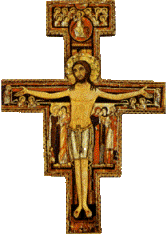
The Mystery of the Cross
Once I read a maxim saying in effect, "Problems are walls to be scaled; Mysteries are pools to be plunged into."
God our Father, in obedience to you your only Son accepted death on the cross for the salvation of mankind. We acknowledge the mystery of the cross on earth. May we receive the gift of redemption in heaven. (Opening Prayer: The Exaltation of the Cross)
I've heard it said that when Jesus entered the Jordan River at his baptism that he consecrated the waters. In a similar manner when he entered his Passion he consecrated all suffering. The understanding and treatment of suffering is one of the attributes that marks a Christian and separates him or her from the mainstream. In a proper sense we strive to alleviate suffering to its irreducible core; and that core is the place where it can no longer be ameliorated, it can only be embraced or rejected. If we embrace it we do so with Christ and with his strength, love and passion, at which point it eventually is overcome, as death is overcome with new life.
But when we reject or disdain our sufferings we resist the power of God in our lives which is always life giving, even as our bodies tend toward their ultimate temporal state, that of death. (We sometimes forget this when we fail to discern the proper boundaries for medicine and healthcare, violating the rights and dignity of all human life and sacrificing others for our own well being. )
It's no coincidence that the Feast of The Triumph of the Cross is followed the next day by the Memorial of Our Lady of Sorrows. Somehow all Christian love passes through suffering in this life. That's one of the keys to the mystery of the cross. In one respect we call Christ the 'Eternal Word of God' because his life communicates all true life (He is the Way, the Truth, and the Life) not only in speech but in the transcendent reality of the Divine One becoming incarnate and consecrating the human condition. The sinless Virgin Mary is not spared from the sorrows of this world because she is so completely united with her Son. His willingness to take on suffering for our salvation and her willingness to accept sorrows because of her union with him are further keys to understanding our role in the plan of salvation.
Thus it's difficult to get one's arms around this mystery unless we are willing to join in an intimate journey with Our Lord and his mother as we enter the 'valley of tears'. The Crucifixion is a scandal and an outrage. It involves humiliation and indignity. It asks us to accept surrender and powerlessness. It cries for justice and asks, "Who is to blame?" These questions often elude us when we are free from pain. But they eventually surface and cry for attention when we are confronted with this mystery: especially when we are trapped in corners where the only escape is the Way of the Cross.
Pope Benedict XVI reminds us at his recent remarks in Lourdes, France that the Lord has bridged immeasurable distance to unite himself with us through suffering and love.
"He is calling you (cf. Jn 11:28)! He wants to take your life and join it to his. Let yourself be embraced by him! Gaze no longer upon your own wounds, gaze upon his. Do not look upon what still separates you from him and from others; look upon the infinite distance that he has abolished by taking your flesh, by mounting the Cross which men had prepared for him, and by letting himself be put to death so as to show you his love. In his wounds, he takes hold of you; in his wounds, he hides you. Do not refuse his Love!"
In Ineffable Wisdom the Lord has chosen to communicate eternal life through his own passion and death and to draw us into the mystery of what this divine suffering means and does for the whole of creation. He has given us the opportunity to transform our own suffering by uniting it with his and offering it to God the Father. As each Christian grows in maturity they become drawn to the reality of suffering and the cross and their need to submit in obedience to its efficacious work, even as it remains mystery.
Living and Suffering Through Sacred Text
One of the greatest joys of life is the illumination of our actual lived experience under the light of the gospel. For the believer, great portions of the mundane happenstance of everyday existence become transformed into new life by the process known as 'going from gospel to life, and life to the gospel'. Even in a place of suffering, life is succored with spiritual meaning when a passage of Scripture imparts its grace in tiny epiphanies. This is how I experience 'spiritual or graced life'; and it's this singular quality that I find lacking in those who swear and insist that gospel living is 'for the birds'.
Gospel verses and canticles carry the breath of spiritual life (grace) as a current, if you will, which imparts actual force into any living soul. The believer, once awakened, begins to sense stirrings due to the vigor of these Scriptural verses. We pull the gospel into our lives, and lo and behold, we begin to experience effects that can be quite moving. Depending on our current state they can be either consoling or disturbing; they have power (sometimes unwanted and unwelcome) which is often emotive as well as intellectual. And yet this testimony of the Word of God is too frequently rendered void or inert. Why?
Often critics or inquirers of faith, look to 'reason' as the high-point of discernment in evaluating any of the claims that believers make. They mistrust sensations, dreams, and even intuition (emotive reasoning) as 'lowly' evidence or foolishness. This is surprising because careful observation shows that 'higher reasoning' alone is hardly ever the quality that impels someone to make life altering changes even in regards to natural matters. Indeed, we've all discovered in ourselves the ability to suspend or deny the dictates of 'reason' in order to avert the 'pain' associated with making important and necessary changes. Often being comfortable or attracted to a pleasurable state far outweighs whatever demands that 'sound reason' would ask of us.
One of the great 'experiments that can be researched and tested' is to take a detached position and witness the effect of Sacred Scripture upon ourselves; believers or nonbelievers alike. The gospel's inspiration or provocation (depending on your relation to its message) doesn't serve to prove anything other than it has a force. Individual's can seek to discern its meaning and validity by their reaction to its demands in the lived experience of their lives. Loose translation: 'The Gospel works or it doesn't'. I suspect that this is the ultimate arbiter of whether we make an assent of 'faith' or not. The existence [or not] of God is not contingent upon a proclamation of my faith; but the 'reality of my faith', (a reality that transcends a mere belief system or coherent framework for living), depends upon the existence of God. This is not absurd or unreal thinking. It's both logical and reasonable.
Sometimes sacred text does allow and even begs us to test its own veracity. Try wrestling with this claim…"Indeed, the word of God is living and active, sharper than any two-edged sword, piercing until it divides soul from spirit, joints from marrow; it is able to judge the thoughts and intentions of the heart."
[Heb. 4:12]. One adage of Christian spiritual life is that 'sin' and the habit of reading sacred scripture cannot coexist: which is to say that a very real effect is discerned when we contrast the 'gospel life' with our own. Even if we don't find the word 'sin' in our moral vocabulary, believer and non-believer alike universally speak in terms of 'good and evil'. The Holy Father, Benedict XVI, provides guidance in that we 'live through' and 'suffer through' the sacred text. It's a challenge for sure, and yet, it's essential if we hope to discover spiritual reality and interpret it correctly. Speaking of interpretation:
The Saints are true interpreters of Holy Scripture. The meaning of a
given passage of the Bible becomes most intelligible in those human beings who
have been totally transfixed by it and have lived it out. Interpretation of
Scripture can never be a purely academic affair, and it cannot be relegated to
the purely historical. Scripture is full of potential for the future, a
potential that can only be opened up when someone "lives through" and "suffers through" the sacred text. [Jesus of
Nazareth; pg 78, Pope Benedict XVI]
What Is God Whispering To You?
And the Holy Spirit did in fact put wind in Pope Benedict's sails as you could see the acuity in his eyes, hear the confidence in his voice, and easily discern the true love for Jesus in his heart. He warned us of evil, but assured us of our triumph. He mapped out the various pitfalls we must overcome and gave us the guidance in rough terrain. He directed us to pray and revealed the need for silence: to listen and be touched by God.
Can a few pages be a catechism? It seems so. This document demands attention,  Now that's a provocative question. The Holy Father asked this and other probing questions to his audience at St. Joseph's Seminary. It was certainly inspirational to those poised to meet the Church's future. At that moment they experienced the presence of the Holy Spirit and his gifts being poured out in superabundance. Too rich a fare to be digested quickly, the pontiff's remarks were something which needed to be captured and pondered. I was fully amazed at the scope of his speech which surveyed quite a bit of ground; it was a lavish display of the good shepherd's loving guidance for his young flock. Shepherd, father, professor, and prayer director: he was all of these in a spectacular display of the Holy Spirit's power.
 prayerful reflection, and application. As these young people will eventually discover; what takes only a few minutes to read will involve a lifetime of transformation. Guided by the Holy Spirit, they will realize that an address that took only a short time to deliver, required the better part of eighty-one years to compose.
The Point of the Third Order
An excerpt from Pope Benedict's Jesus of Nazareth (pg. 79)
Here Pope Benedict is writing about The Beatitudes, specifically the first...Blessed are the poor/Blessed are the poor in spirit....and after commenting on Francis' most radical response he takes up the role of the lay/secular followers of Francis. He writes;
"......For [Francis] did not want to found a religious order: He simply wanted to gather the People of God to listen anew to the word---without evading the seriousness of God's call by means of learned commentaries.
"By creating the Third Order, though, Francis did accept the distinction between radical commitment and the necessity of living in the world. The point of the Third Order is to accept with humility the task of one's secular profession and its requirements, wherever one happens to be, while directing one's whole life to that deep interior communion with Christ that Francis showed us." (emphasis added)
This is for most a lengthy transformation. Initially, these appear as competing interests; the profane (we might even call it mundane worldly endeavors) vs. the sacred aspirations of union with God's will. But each realm makes legitimate claims on our life; and in time we grow in the awareness that it's not competition but integration...a truely sacred secularity. A secular life made holy.
In the early stage of our formation this division of our time between the sacred and profane realms is often seen as struggle. It can cause tensions and frustrations and deprive us of the sought after 'fruit' of our efforts; something as pure and simple as joy.
We need to keep in mind that this 'acceptance with humility of our secular profession with its requirements and tasks while directing the whole of one's life to Christ' does not mean that we merely 'put up' with the mundane circumstances. That would be like 'putting up' with unpleasant conditions for 50 weeks to enjoy 2 weeks vacation.
At some point we begin to understand that the secular world is not something to be avoided or marginalized but brought into the realm of the sacred and lifted up, so to speak. Then we begin to witness our own transformation. For in this 'lifting up of the secular/profane' (and that is exactly what a Secular is called to do) we are responding to our vocation, God's express call to us and his will for us.
To state this another way, The Secular Franciscan in the process of "...directing one's whole life to that deep interior communion with Christ that Francis showed us...." cannot leave the world behind; otherwise he misses or misinterprets his original call to vocation.
For me it is a slow gradual process of meshing my secular life with the will of God; which He reveals to me daily in all my activities if I take the time to listen.