Showing posts with label Rebuild My Church. Show all posts

The Saint and the Sultan


The Crusades, Islam, and Francis of Assisi's Mission of Peace

[A mixture of reflection and book review]

May the Lord give you peace.

It seems that the death of bin Laden has had a mixed effect on me, causing me to search for a real gospel approach to the problem of enmity and hatred. Through twists and turns I discovered the book The Saint and the Sultan by Professor Paul Moses. As soon as I entered its realm, I found myself open to its inspiration and nourished by its meaning. What I discovered was the 'sonorous voice of St. Francis' singing a neglected gospel canticle of peace and reconciliation to a world trapped in an unholy embrace of hostility and death.

The author is a journalist, not a historian, nevertheless he utilizes extensive travel and research into the life and times of St. Francis. The Seraphic Saint is revealed beyond the traditional sources through additional chronicles, journals, and documents. There are substantial notes and references, yet its very readable. The portrayal of St. Francis is very convincing, because we see him committed to the gospel in a way that signals his uncompromising belief in the transformative power of love and pardon. (see Article XIX, SFO Rule)

One of the goals of the book is to reignite Francis of Assisi's missionary vision of peace among peoples who are estranged.  To understand what Francis has to say we must first see his conversion in the context of his lived experiences, particularly his intimate contact with war; its bloodshed, imprisonment, and all the other demons that swirl around the battlefield. This perspective is what makes the book a success. It's into this wounded and tortured soul that the seeds of the gospel find their mortified soil.  Now the young Francis is sufficiently transformed to encounter the Savior in his vision.  From here he laucnches into a new life of penance and poverty with no restraint.

The Saint and the Sultan attempts to explain why the message of St. Francis (specifically regarding his attitude toward war) is clouded. According to the author, those attempting to convey the charism of Francis are caught in conflicting cross currents. Then as now, the first casualty of war is truth.  The aura of St. Francis had to pass through a Church mired in difficult circumstances. Even the rivalry within the early Franciscan Order plays some part in altering the sublime message.

Perhaps this 'cover up' is the most controversial claim of the book. Nevertheless, I chose to align with the stated goal of revealing St. Francis as the model of peacemaker in the highest order.  The radical expression of the gospel as shown in the life of Francis remains the more relevant message and overshadows the need to find a conspiracy. 

The Church of his time is in disarray, but we already knew this, since Christ himself spoke to the Poverello…'Francis, go and repair my Church, which you can see is falling into ruin'. The real and imagined heresies bred suspicion and anxiety and raised the specter of severe condemnation, even death to those taking opposing positions. Professor Moses reveals to his readers the historical scene and its relevant characters candidly, yet he meticulously sticks to his theme while sparing his readers a diatribe. This is one of the subtle lessons of the book.

During the lifetime of Francis, the relic of the 'True Cross' accompanied the Crusaders into battle. Thus the Cross became both divine protection and weapon against the foe. One's standing with God was manifested in the winning or losing of the battle; but either way, the mission was deemed sacrosanct. While the worldly Francis would have applauded this, the penitent Francis came to see through it with a more penetrating vision.

For Francis in his journey, the 'True Cross' remains a symbol of victory; but one of victory over sin and death. The power of the Cross is inherent in one's surrender to the Will of the Father, which Christ did in accepting the burden of the sins of the world. For Francis, this giving of oneself to God (for Christians through Christ) is in some manner recognizable in the belief of the Saracens. The term 'Islam' means 'submission to the will of God and obedience of His law'. Francis indeed wanted to convert the Saracens (not merely coexist with them), but he already recognized and affirmed the innate image of God in the hearts of the foe. For Francis, to enter into mortal battle with others contained no glory, but rather came to signify a tragedy; a nullification of the gospel itself.  'Love your enemies, pray for those who persecute you.'

For me there are two important findings in this work. One is a real satisfaction in having contemplated a more lucid understanding of St. Francis; he's always been more enigmatic than I'm comfortable with. For this alone, The Saint and the Sultan deserves to be recognized as a contribution to the understanding of the Poverello. I'm grateful for having seen a new perspective which actually strengthens my commitment to his way of life.

The second finding is the promotion of a message that's been obscure and badly needed. To my mind, the practice of gospel peacemaking as St. Francis shows is not tied to consensus thinking nor does it require the approval of others. It is willing to go it alone with its only requirement being a purified heart and faithful recognition of the divine seed in the other. The other is never evaluated in terms of their moral state or worthiness; love and pardon are extended unconditionally. Even the prospect of a failed attempt at peace is unimportant; indeed it is a distraction, because the work of bringing gospel love and forgiveness is life-giving to the bearer and efficacious to the world, even when it is scorned.

Comments welcomed.  Peace and all good.

The Primordial Relationship

The essence of religion is the relation of man beyond himself to the unknown reality that faith calls God. It is man's capacity to go beyond all tangible, measurable reality and to enter into this primordial relation. Man lives in relationships, and the ultimate goodness of his life depends on the rightness of his essential relationships—I mean father, mother, brother and sister, and so forth—the basic relationships that are inscribed in his being. But none of these relationships can be right if the first relationship, the relationship with God, is not right. This relationship itself, I would say, is, properly speaking, the content of religion.

(Joseph Cardinal Ratzinger – Salt of the Earth)

The above is an insightful response to a question many have regarding the essence of religion. What I find interesting is the awareness of proper ordering of relationships; that it's in discovering and giving priority to the relationship with God which guides and nurtures all other relationships successfully. Even if we allow for the fact that many people discover this 'Primordial Relationship' through other relations; we must still conclude that the proper disposition of our relationship with God (it's rightness) is what enables us to get the other relationships 'right'.

In religious terms this means placing our relationship with God first and above all others. The skeptical world views this as a scandal, because it falsely interprets this to mean interference, or worse, a degradation of the natural movement of human affairs. Scriptural passages which focus our love, obedience and attention to our Creator, sometimes appear overbearing to the nonbeliever and confusing to the novice believer.

The danger here is twofold. On the one hand we can form rigid notions of religion in which we view it as a set of preset instructions or commands and fail to participate in a real manner of listening and responding to what God is directing us to in our unique mission. On the other hand, we can ignore the parameters of this 'primordial relationship', created for our own good and the good of others, and instead create foolish and destructive patterns of behavior that appear fulfilling and loving while distracting us from getting our relationships 'right'.

I'm somewhat concerned that so many have entered into these 'other relationships' (family and beyond) without the proper footing that comes from recognizing and developing the 'primordial relationship'--communion with God. Societies are struggling and families failing because they lack the connection and guidance of that supernatural relation to God. The overarching role of religion in our lives is to correctly form the 'primordial relation', which can then be relied upon to form all other relations 'rightly'; with true love, integrity, justice and compassion.

So true religion has the fearful task of calling individuals to the 'primordial relationship'; and beyond this it also has the task of informing and shaping that relationship. To complicate matters it has to do so in a contentious arena where a host of voices clamor for attention and legitimacy. In all of this the individual must respond, not because of coercion or power, but because he or she is created for the purpose of living in this relationship and in communion with others. The faith involved is not for the purpose of making life easy but for the purpose of making life real.

"Man lives in relationships, and the ultimate goodness of his life depends on the rightness of his essential relationships." Indeed, this is a crucial test of goodness not to be underestimated. The 'rightness' of our relations grows from family outwards to the fraternity of all mankind, especially those in need. So getting it 'right' seems to be of paramount importance. "But none of these relationships can be right if the first relationship, the relationship with God, is not right."

Francis Entered Where Theologians Stand Outside

St. Francis had never studied Sacred Scripture, but unwearied application to prayer and the continual practice of virtue had purified his spiritual vision, so that his keen intellect was bathed in the radiance of eternal light and penetrated its depths. Free from every stain, his genius pierced to the heart of its mysteries and by affective love he entered where theologians with their science stand outside. [Bonaventure; Major Life; Chapter XI; Section 1]

What St. Francis receives as 'eternal light' is never wasted; it is carefully pondered and diligently acted upon. This dual response of reflection and action (especially penitential action) sets him apart for God's spirit; so much so, that what is commonly received, even in the sacramental graces available to all, is in St. Francis raised to mystical heights.

Growth in understanding along with purification of body, mind and soul, went hand in hand in his ascent to sanctification. Each insight was a precious seed to be nourished and cultivated to full development. Not only deep meditation, but intense action was his road of holiness. Mortification of all spiritual distraction was continual; whether in his body, mind or soul. Each insight he received involved not only an understanding to gaze upon, but a decision to act upon. At each step he was carefully transformed into the likeness of Christ through insight and knowledge, along with continual 'dying to oneself'.

I am finding that my own spiritual growth lately comes in short burst where small and simple insights are strained and studied. What's missing for me is what St. Bonaventure refers to as the 'continual practice of virtue'. Pondering sacred scripture without 'the practice of virtue' is like hopping along on one leg. What St. Francis preaches by his own life, is that racing toward God takes two legs in coordinated strides: one of understanding and knowledge, the other in penance and bodily mortification. Knowledge of divine affairs and mortification of human affairs go together as complimentary characteristics of spiritual life: either alone is incomplete.

This 'inconvenient truth' is tempting to run away from, but we do so at our own peril. As difficult as the practice of penance is to embrace, it's critically important in revitalizing the Church and its members. We simply cannot reduce the spiritual life to a longing for union with the divine, without the elements of purification and mortification of our human nature. It's this integration of 'knowledge' and 'practice of virtue' in all its fullness that's at the heart of St. Bonaventure's observation: 'Francis enters where theologians stand outside'.

This lesson is beneficial for all members of the Church. It is hallmark for those of us who are called to spiritual life in the way of Francis. The twofold way in which the Seraphic Saint responded to the promptings of the Holy Spirit might today be called 'holistic' in that it embraces body, mind and soul. It transforms us more completely and more quickly. It directs our relationship more properly to God and neighbor. To carefully unpack the opening words of St. Bonaventure sets a framework for understanding and applying Franciscan spirituality. Hopefully my short reflection won't confuse the issue.

So after twenty plus years of profession it's time to begin anew; to re-enter with fresh insight the heart of the Franciscan calling: "The rule and life of the Secular Franciscan is this: to observe the gospel of our Lord Jesus Christ by following the example of St. Francis of Assisi, who made Christ the inspiration and center of his life with God and people." [Article IV: The Way of Life]

The Gospel is Audacious

[A continuation in a series of reflections labeled 'Rebuild My Church']

The 'good news' of the Gospel must certainly appear audacious, if not an incredulous message to non-Christians in today's postmodern world. Even with two thousand years of reaching through human history the claim of 'rising from the dead' is always bold; beyond that, the Beatitudes sound imprudent and risky to unbelievers. Because the Gospel is pregnant with Spiritual Life, it must be presented with utmost care.

Most non-Christians don't receive the Gospel in a coherent manner; they hear it in bits and pieces. They hear it within their own frame of reference, usually with great skepticism, which often includes cynicism, sarcasm, and prejudice. And they hear it within their own psychological security zone which for most of us yields to a strong desire to be protected by the norms of our culture. For the most part we seek the majority of others to validate us; so if it's not within the family of God, with God as our Father, we will turn to other groups or associations for our image of who we are.

The evangelization of our Faith comes about mostly through the testimony of our lives well before it reaches the stage of catechesis. It comes about through genuine friendships where faith is displayed in practice in the everyday affairs we encounter. And it goes both ways: the values of friends can and will rub off on us. It's my belief that what we witness as the secularization of our (western) culture is really nothing more than the net outcome of all of these personal interactions which happen each and every day.

If this is so, then the rebirth of evangelization comes about through an intensifying of conversion experience in existing believers. This is not happening often enough. Much of the decline in Christianity is due to the 'boldness' of the Christian Gospel being 'toned down', so to speak, in order to appear more modern and enlightened. Indeed, the headiness of rapid scientific advance has created an illusion that all truth and meaning are contained in the realm of objective reality and reason. Divine Revelation is discarded as superstition, nothing is 'revealed' to man. All knowledge is discovered and evaluated: accepted or rejected based upon its utility or desirable consequences.

There are both temporal and eternal dangers here. Secularists have become overconfident and imprudent in completely shedding the counsels of wisdom from above. What is undesirable is termed 'evil' and destroyed; it could be any unwanted life (not only the unborn) or any other suffering agent. Ethical systems are subject to consensus thinking, where the majority creates 'truth: right and wrong'. One nation that condemned another for the practice of eugenics a generation ago, is now condemned in turn for the practice of cloning and splicing human and animal genes into 'hybrids'. Times change and values change quickly and easily in the secular temporal order.

The reality of mankind's relation to God is bound to reassert itself; for the roots of 'faith, hope, and love' dictate that a world without grace will always reach its lowly limits, as surely as all human edifices have in the past. Christians through their willingness to live the Gospel life fully can and will bring the boldness back to the Gospel message.

By resuscitating ancient practices such as unconditional love and forgiveness, love of enemies, compassion for the suffering, self-giving and dying to oneself, they bring spiritual light to a darkened world. In bearing their sufferings as true disciples they hold up Christ crucified as redeemer to all who suffer. By renewing their commitment to the visible Church in public worship, faithfully and in large numbers, they manifest the mystical Body of Christ. In renewing practices of prayer and penance; scripture meditation; re-dedication to the Sacraments, and personal conversion: they give themselves to the Holy Spirit as agents for change. Undoubtedly, the Spirit has already begun.

Rebuild My Church

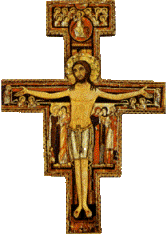
I suppose that anyone who has ever heard the story of St. Francis in the chapel of San Damiano becomes susceptible, sooner or later, to a similar awakening. From the Crucifix in the broken down chapel Our Lord repeats to St. Francis three times…"Francis go and repair my house. You see it is all falling down." At first the direct vision terrified him, but eventually the message penetrated his heart and he went into ecstasy, says St. Bonaventure. After a period in which he physically repaired many run down local chapels, the Holy Spirit made him realize that his mission was to the universal church: this is what St. Francis later explained to his friars.

My awakening came recently while joyfully exploring a survey post entitled 'What is the Religious Climate in Your Country?'. Mostly, some very faithful Christian stalwarts reported on religious realities outside of the U.S.A. Even some generous nonbelievers lent their comments in a kindly sharing of their observations. What was different about this survey was that its 'value' was in the narrative comments; not in some dry statistical summation of which we have all seen ad nauseum. I hope that Jennifer F. over at 'et-tu?' develops the survey responses into future posts, and for that reason I will try to restrict my remarks, for now, to the issue that moved me the most: the Church in decline.

I guess I should begin by describing my reaction so that you can gauge my response as 'on' or 'off' target.

I felt a sense of angst, a true existential dread; as nearly every response (when taken as a whole) pointed to a tide of secularization that has swept over what many would have described as, Christian nations. As I said, most of the responders were the faithful stalwarts who were 'holding the line', so to speak. Yet from my perspective, they described myriads of Christians who were dropping like flies into the clutches of Secularization and Relativism. America herself is certainly not immune from this force, particularly my region of the nation. I live in a State that, on paper, is largely Catholic and predominantly Christian, but far too often that is very difficult to discern. Again, none of this is news for those who have been following trends but I was completely dumbfounded by my own visceral reaction: and thus my 'awakening'.

I don't expect that many others felt a similar response, nor do I maintain that they should have. After a few days of praying about it, I sensed that it was merely a personal revelation, but a revelation that deserves consideration and action. One of the ways I will respond is to reflect and blog about it in a systematic manner. Today I am creating a 'label or category' of posts titled 'Rebuild My Church'.

One of the goals of this ongoing reflection (with your help) is to give new impetus into ways that we can gently confront this oncoming tide. I sense we need to explore and pray about our fears that we experience in witnessing (or not) to Christ. Some areas of concern are:

  • What are the true costs and rewards, both temporally and spiritually?
  • How is the Secular culture affecting us in our daily lives: do we change it or does it change us?
  • How does a Christian know where the boundaries are of authentic evangelization, without trammeling over the 'free will' that God has given to all of his children?
  • How do the Christian faithful stand up for their own beliefs and practices in a pluralistic society, without having them become so diluted in meaning and purpose, as to become 'worthless salt'.

Considering the Church's struggle in our own times we must consider practical solutions through listening and discerning what the Holy Spirit is saying. The Spirit is our guide. The first step may be in realizing that this Spirit is calling us here and now to 'move the mission' of the Church. I guess I would call that my 'awakening'.