Showing posts with label Francis. Show all posts

The Saint and the Sultan


The Crusades, Islam, and Francis of Assisi's Mission of Peace

[A mixture of reflection and book review]

May the Lord give you peace.

It seems that the death of bin Laden has had a mixed effect on me, causing me to search for a real gospel approach to the problem of enmity and hatred. Through twists and turns I discovered the book The Saint and the Sultan by Professor Paul Moses. As soon as I entered its realm, I found myself open to its inspiration and nourished by its meaning. What I discovered was the 'sonorous voice of St. Francis' singing a neglected gospel canticle of peace and reconciliation to a world trapped in an unholy embrace of hostility and death.

The author is a journalist, not a historian, nevertheless he utilizes extensive travel and research into the life and times of St. Francis. The Seraphic Saint is revealed beyond the traditional sources through additional chronicles, journals, and documents. There are substantial notes and references, yet its very readable. The portrayal of St. Francis is very convincing, because we see him committed to the gospel in a way that signals his uncompromising belief in the transformative power of love and pardon. (see Article XIX, SFO Rule)

One of the goals of the book is to reignite Francis of Assisi's missionary vision of peace among peoples who are estranged.  To understand what Francis has to say we must first see his conversion in the context of his lived experiences, particularly his intimate contact with war; its bloodshed, imprisonment, and all the other demons that swirl around the battlefield. This perspective is what makes the book a success. It's into this wounded and tortured soul that the seeds of the gospel find their mortified soil.  Now the young Francis is sufficiently transformed to encounter the Savior in his vision.  From here he laucnches into a new life of penance and poverty with no restraint.

The Saint and the Sultan attempts to explain why the message of St. Francis (specifically regarding his attitude toward war) is clouded. According to the author, those attempting to convey the charism of Francis are caught in conflicting cross currents. Then as now, the first casualty of war is truth.  The aura of St. Francis had to pass through a Church mired in difficult circumstances. Even the rivalry within the early Franciscan Order plays some part in altering the sublime message.

Perhaps this 'cover up' is the most controversial claim of the book. Nevertheless, I chose to align with the stated goal of revealing St. Francis as the model of peacemaker in the highest order.  The radical expression of the gospel as shown in the life of Francis remains the more relevant message and overshadows the need to find a conspiracy. 

The Church of his time is in disarray, but we already knew this, since Christ himself spoke to the Poverello…'Francis, go and repair my Church, which you can see is falling into ruin'. The real and imagined heresies bred suspicion and anxiety and raised the specter of severe condemnation, even death to those taking opposing positions. Professor Moses reveals to his readers the historical scene and its relevant characters candidly, yet he meticulously sticks to his theme while sparing his readers a diatribe. This is one of the subtle lessons of the book.

During the lifetime of Francis, the relic of the 'True Cross' accompanied the Crusaders into battle. Thus the Cross became both divine protection and weapon against the foe. One's standing with God was manifested in the winning or losing of the battle; but either way, the mission was deemed sacrosanct. While the worldly Francis would have applauded this, the penitent Francis came to see through it with a more penetrating vision.

For Francis in his journey, the 'True Cross' remains a symbol of victory; but one of victory over sin and death. The power of the Cross is inherent in one's surrender to the Will of the Father, which Christ did in accepting the burden of the sins of the world. For Francis, this giving of oneself to God (for Christians through Christ) is in some manner recognizable in the belief of the Saracens. The term 'Islam' means 'submission to the will of God and obedience of His law'. Francis indeed wanted to convert the Saracens (not merely coexist with them), but he already recognized and affirmed the innate image of God in the hearts of the foe. For Francis, to enter into mortal battle with others contained no glory, but rather came to signify a tragedy; a nullification of the gospel itself.  'Love your enemies, pray for those who persecute you.'

For me there are two important findings in this work. One is a real satisfaction in having contemplated a more lucid understanding of St. Francis; he's always been more enigmatic than I'm comfortable with. For this alone, The Saint and the Sultan deserves to be recognized as a contribution to the understanding of the Poverello. I'm grateful for having seen a new perspective which actually strengthens my commitment to his way of life.

The second finding is the promotion of a message that's been obscure and badly needed. To my mind, the practice of gospel peacemaking as St. Francis shows is not tied to consensus thinking nor does it require the approval of others. It is willing to go it alone with its only requirement being a purified heart and faithful recognition of the divine seed in the other. The other is never evaluated in terms of their moral state or worthiness; love and pardon are extended unconditionally. Even the prospect of a failed attempt at peace is unimportant; indeed it is a distraction, because the work of bringing gospel love and forgiveness is life-giving to the bearer and efficacious to the world, even when it is scorned.

Comments welcomed.  Peace and all good.

Do You Have a Plan of Life?


“The spirituality of the Secular Franciscan is a plan of life centered on the person and on the following of Christ, rather than a detailed program to be put into practice.” (Article 9: SFO General Constitutions [GC].

In an earlier reflection I remarked: “What is characteristic of a spiritual family or tradition is that it embodies a ‘spirituality'; which is another name for a 'way', a 'path', […] which guides us towards our calling: Living the Gospel in union with Christ.” With that in mind let’s examine the article above from our SFO General Constitutions.

How often do we even think about a ‘plan of life’? Are we generally aware of any purpose or plan? I have to sadly admit that too often I find myself drifting through life aimlessly, shielded by habits and routines developed to maximize comfort and avoid stress. This might mean that I have a set of conflicting life plans, or one anemic plan, etc., you get the point.  Just writing this makes me aware that I need a course correction…a boatload of ongoing conversion.

But our spirituality calls for a ‘plan of life’ that is centered on the person and on the following of Christ… This is a plan based upon living in a real relationship with the person of Jesus, one that should be growing through inspiration and prayer in clarity of purpose, and deepening in commitment over time. We should see our lives resembling the gospel more and more.

Since we are individuals with different talents, inspirations and circumstances, we have unique plans of life; but what they should have in common is that they are ‘centered on the person and on the following of Christ’. As our Seraphic Father has said, “I have done what is mine to do, may Christ teach you what is yours to do.” (2Celano, 214)

In my opinion, the main goal of never ending Fraternity formation is to develop and animate our ‘Christ-centered plan of life’. This includes the difficult process of our own transformation (what Franciscans call ‘conformation’): that dying to self and living in Christ. The foundation to all of this is persistent prayer and reflection on the gospels…going from gospel to life and life to the gospel. (Art.IV, SFO Rule)

So, if we’re responding to a genuine call, our initial task becomes a radical reorientation of ‘our own life plan’ (some might call this repentance), to one based upon the person of Jesus: to bring forth his presence and to do his will. We’re successful to the extent that we’re united in Christ and that we reveal him to one another. Yet even more mysterious is when Christ disguise’s himself in us in order to accomplish his Will.

Somehow we need to call to mind what it is that the Franciscan family represents; and to know its mission in the Church and in the world. From that perspective, how are you preparing for your mission…do you have a ‘plan of life’?

Being Mothers to Our Lord Jesus


[This post is a revised reflection.  Peace and all good, Tausign]


"We are mothers when we carry him in our heart and body through divine love and a pure and sincere conscience; we give birth to him through a holy life which must give life to others by example." -St. Francis of Assisi-

One of the greatest joys of our mortal existence is to experience the 'immanence' of God. The 'incarnation' of Christ means that which is pure 'Spirit' enters into our humanity in every way except sin. God could have stayed 'outside' of creation: 'non-incarnate' and aloof. But He didn't.

Not only that, but all of Creation can now rejoice because the Creator has revealed himself in its midst. The Canticle of the Creatures, throws new light on a sublime relationship. The sun and the moon could always give glory to their Creator, but they did so as material evidence of the Creator's work. But now because Jesus has looked upon them with his human eyes and felt the warmth on his human skin, they become 'transformed', if you will, with all of Creation. All of Creation 'praises' the 'eternal God' through Jesus. All in Creation are related to each other as kin, through Jesus.

Mary's role in all of this is the basis for St. Francis' undying devotion to her. The early writers say The Poverello loved her with what is called 'inexpressible love'. Her loving fiat, 'be it done unto me according to thy word', is the indispensable cooperation of Mary for the human family. She is the gateway to incarnation of the divine Person of Jesus.
It wouldn't hurt to occasionally ponder what having 'God incarnate' means to us as pilgrims in the temporal order. First of all, Jesus reveals how we are related to God in new terms. The Eternal Son, touches us: he becomes our 'brother', sharing with us his mother; and makes a transcendent God, our 'Father'; even 'Abba'. We share in 'his life' because he has taken on ours.


For St. Francis, Mary herself is a beautiful hymn proclaiming humility and exaltation together as a single chord. She is 'humble', as divine handmaid, completely open to the goodness of God. Her 'exaltation' is the received dignity due the mother of God. 'The Almighty has done great things for me...' Indeed, all generations will call her 'Blessed'.


Though we haven't received her singular graces, nevertheless, our Heavenly Father, in his providence provides what we need to accomplish his will for us. So in recalling the refrain of St. Francis stated above, we should count on the Holy Spirit through Mary, to bring about the 'birth' of Jesus in ourselves. To 'carry Jesus in our hearts and body' and to have him 'give life to others by our example' means necessarily our own dying to ourselves. This is of course the sticking point: the need to accept a baptism of death to our worldly way of life; and a rising to new life in Christ Jesus.


God can move deeply into our lives: but not without our consent. Our Heavenly Father has chosen us for something special; to carry His Son and to reveal Him to others. And if a thousand billion others are called to the very same task it still is glorious to undertake. I'm speaking of course of the awesome task of being 'mother to our Lord Jesus Christ'.


It is in Giving that We Receive

One of the reasons I love the Franciscan way of life is its willing acceptance of the paradoxes of Christian life. Followers of Francis have that seemingly odd spiritual sense of embracing what the world finds absurd. It's a quality of finding what you're not looking for by searching for the wrong thing. For instance, striving to become the leader and discovering that a true leader is really the servant of all the rest. We grow by becoming small, rather than lording it over others. We receive by giving, not taking. We discover a rich life through spiritual poverty or we find true greatness in holy humility. (Note: I count this uncommon quality as an authentic sign of a Franciscan vocation; conversely someone who resists this inclination is applying at the wrong door.)

Of course Franciscans don't own this quality, it's basic to Christian spirituality; but it is a hallmark of our spiritual family. Other paradoxical traits include simplicity and pardon. Simplicity disarms cunning and overcomes worldly wisdom (which is really foolishness). Forgiveness and love have the power to sting a wrongdoer and may ultimately transform a heart to goodness (see Article XIX of the SFO Rule). To follow Francis is to necessarily enjoy the paradox of finding our strength (which comes from God), in our weakness.

This quality is heralded in The Prayer of St. Francis: (an excerpt)

For it is in giving that we receive, It is in pardoning that we are pardoned, And it is in dying that we are born to eternal life.

We could easily misunderstand or limit our understanding of the above passage. We might conclude that when we give, we begin a chain reaction that results in our receiving something in return. This is the world's rationale. Or again, when we pardon, we're setting a good example, and therefore we might hope it will be contagious and spark a return. Indeed, sometimes this is the case. Nevertheless, whether we receive anything back, or are pardoned in return, is actually irrelevant to the greater good of uniting with the Will of God.

Sadly, our experience teaches us that our gifts are often spurned and our forgiveness is usually trodden underfoot. As bad as that seems it gets worse, because we foolishly translate this into disappointment in others, and sometimes in God. We often judge our own uncharitable ways as justified, because we gave but did not receive in return. But here in the world's disappointing behavior St Francis finds an inverse response to the situation; he shows us joy, something Francis referred to as 'Perfect Joy'. (If you're unfamiliar with 'Perfect Joy', click here.)

What the Prayer of St. Francis says to me is that when we give of ourselves, we do as God has shown us in the giving of his Son Jesus; and we simultaneously receive the gift of the Son. When we pardon from our hearts unconditionally; we pardon others in the manner God has pardoned us; and in doing so, we receive our own eternal pardon. Finally, and perhaps most paradoxical, we must hasten our death to our own unhealthy inclinations. When we're ready to immerse ourselves in a baptism of death to the old man, only then are we ready to rise to new and glorious life.

For those of us who are professed into the Order, we have the responsibility to live out these inverse qualities of poverty, humility, simplicity, chastity and all the rest, in manner appropriate to our state in life. In doing so to make it clear that Jesus is present in us and to not obscure his image in any way. If we fail to show this life we're squandering precious time (Mea Culpa).

Standing on My Head Does Hurt

…But it's worth it to get the most insightful perspective.

[This reflection was originally posted on 2/28/08. Since it bears on the election and since I've been distracted of late by the election process, I'll offer it again. Peace and all good. --Tausign]

G.K. Chesterton noted of my beloved St. Francis; "He who has seen the vision of his city [nation] upside-down, has seen it the right way up." It's the ordinary vision of live (i.e. the worldly way) that lacks imagination. And it's the gospel way of life, with its foolish imaginary ideals, that holds the greatest hope.

As we contemplate the upcoming electoral process the focus of national attention will be upon the candidates. I take the election process as solemn duty with utmost seriousness: but with no illusion. For the cause of change that most people seek is not in the leadership; at least not in a democratic nation such as ours. No, the true cause of change is in the electorate; for there lays the problem and the solution.

The general population is apt to think that we are 'victims' of our own political process: never feeling satisfied with the outcome and rarely being united, unless some large common foe forces us, through fear, to band together. For the most part we view the problems that must be addressed as other than our own: personal problems, faults, miscalculations, or misdeeds of others. The corollary of this is that the interests that must be defended are usually our own: in fact these interests are often in opposition to the interests of others.

This is the stark reality: and it is quite upside-down.

At another blog the topic of late is; what qualities are necessary to define a good candidate? This is an important consideration for sure, but as much as I disdain cynical thinking, I nevertheless commented with this skeptical remark:

"A fearful people will get a tyrant to protect them. An avaricious people will get a salesman to provide what they simply must have. A people unwilling to feed themselves will get someone to feed them. But a nation of people who are not afraid; are not greedy; and are willing to provide for themselves and perhaps a neighbor to boot...well they might call forth a person of humility."

Why should we look for and expect qualities in a candidate that are not manifestly sought after in a personal way by the electorate as a whole? Seriously, if you think the culture is in decline and decay and the vast majority has lost their senses on vital matters: then how can we reasonably expect a political solution? The best possible outcome would be for the 'right thinking' few to somehow pull an upset, and force by some 'set of rules', others to fall in line. That's just upside-down thinking.

And this is why so many default to seeing the whole process as a subjugation of a true majority of 'right thinking' citizens somehow being overpowered by nefarious entities: the manipulating media; profit hungry corporations; evil special interests, (the list is endless). They 'thwart' the 'right thinkers'. All manner of theories arise (with some half truths thrown in for veracity) which explain how our power is exorcised from our hands. Have you noticed that these groups are always made up of 'them'…and never of 'us'?

This is why the gospel never speaks of a political solution to the woes that we endure. My political theory is thus: The political process merely reveals the state of conversion of a nation. A virtuous nation will call forth a virtuous leader. When we fight and win the conversion battle (beginning with ourselves), then we won't need the political savior…we won't cry out for Barabbas to lead our cause. As important as the political battle is; it pales in comparison to the battle for conversion of the nation. The priority must be correct.

My greatest hopes and endeavors are focused not so much on the nation, but on the Kingdom within the nation. My battle is from the inside-out (my own conversion first and by extension others around me). Many, (surely not enough) have been praying and fasting, and will continue to so for our upside-down nation. We've begged God through his Holy Mother to shower graces upon us. Now we need to incorporate the graces. The solution is nothing less than a life of enduring penance as Our Lady has told us, repeatedly.

If the Christian community in particular continues to take a secular approach and avoid penance, then we are in for the longest of long pulls. As I remarked in in a post some time ago:

"Contemporary opinion of the practice [doing penance] is often seen as unnecessary and ludicrous; outdated and old fashioned; even backward and harmful. Yet, when the practice of 'doing penance' is put into actual usage, it quickly loses its absurdity and induces a sense of wisdom and good judgment."

To borrow a metaphor from an earlier reflection: Penance must precede great moral change as surely as a needle must precede the thread. Abortion, war, pornography, torture, poverty, drugs and a very long list of evils will simply not diminish unless and until a much larger conversion of hearts takes place. Some tipping point must be achieved. To imagine a world of less evil without great conversion is ludicrous. So if we imagine that we can push threads through fabric with our bare hands (for that is what relying on the political process alone entails) we are fooling ourselves. Penance is the indispensable means to both pierce the fabric (our hearts) and pull through the threads of our desire for change. "Let us begin anew, for as yet we have done nothing" (St. Francis of Assisi).

Birdbath Francis

Birdbaths and St. Francis go together like ham and cheese--so it seems. The modern world has grown up with a lawn ornament saint, whose reputation and character have been set adrift and nearly lost. I occasionally encounter remarks similar to this:

"I finished Chesterton's St. Francis of Assisi. What a glorious little book. It has helped me to regard St. Francis in a very new way. I've always been rather cool toward him, probably mainly due to modern stereotypes, myths, and sentimentalities… the whole Medieval Flower Child thing, you know. I know it's horrible, but that's pretty much the (fake) image of St. Francis I've grown up with."

So says one of my blogger favorites, The Practicing Catholic…and she's not alone. I'm guilty of starting with a similar misconception of Francis. In fact, I've confessed often that my beginning knowledge was 'less than zero' and fraught with glaring errors. Still, as one who has devoted considerable time and prayer getting to know St. Francis, I've become attuned to remarks which echo this sentiment. Since his image is so well known, even 'iconic', it sometimes lends itself to a childish caricature. Because he is highly recognizable, generally admired, and widely misinterpreted; he is free to be associated with whatever fancies the world finds useful: all with little objection or scant historical accountability.

Culturally, we make Francis fit our own needs and desires rather than bring ourselves to his sanctity. Take the matter of promoting peace. Young Francis was a captured soldier who later learned that personal sacrifice and penance precedes peace in the way that a needle precedes thread. All too often, we as worldly peacemakers focus on the change that's required in others--not ourselves. This is true whether we brandish words or bayonets. As a spiritual peacemaker, Francis typically brought parties together and created circumstances for peace to emerge. Brother or Sister Peace was a spiritual guest who never failed a proper invitation. It was not his manner to impose peace or mandate its presence.

His loving attentiveness of creation marks his love of the Creator. This is what the environmental movement unwittingly prays for, if it seeks to call upon Francis as patron. The sun, moon, stars, sheep, worms, and birds; all give glory to God by their own nature and in their own way. For St. Francis, they are worthy of respect not only because they are created by God, but because Our Lord had deigned to enter into his own creation. In the way of Francis, creation is blessed because the Eternal One who is Creator has 'emptied himself' and become incarnate; he has looked upon the sun with his human eyes, and felt its warmth on his face. Brother Food nourishes the Savior's body and Sister Water slakes his thirst. This is ecstasy to the Saint who is Brother to the Divine Savior and all of creation. Francis also values mankind's role as co-creator in the material realm, so long as he serves the divine plan accordingly.

Through the gift of eternal light the Penitent of Assisi sought to rid himself of all unworthy attachments of body, mind and soul that interfere with our proper stance before God. Nowhere is the spirit of St. Francis more lacking today than in the worlds' complete disdain for the practice of penance as virtue; otherwise known as 'doing penance'. It's an indispensable element in aligning the human spirit with the divine plan. Poverty and humility are the hallmarks of his path, and 'doing penance' is the academy in which the individual grows in his relationship with God. For Francis, the Holy Spirit 'makes his home and rests upon' those who do penance. Those who refuse to do penance are trapped in their carnal desires, blind, full of anxieties, and lacking in Wisdom from above.

His mystical heights are for some an embarrassment in a world that has locked itself in temporal chains. This devaluation of mystic qualities in Francis has left him appearing awkward, with some of his behaviors seemingly harsh, odd, or unexplainable. One of the keys to accepting an authentic vision of Francis is to humbly acknowledge the many extraordinary gifts he possessed, while simultaneously avoiding the need for sensationalism in our own religious experience. The gift of the stigmata, the divine seal, marks him with God's favor. And if holes in his body were not enough, his skin formed the shape of nails themselves that could be touched and moved within the palms and feet. Though he tried to hide the stigmata while living, many bore testimony to having witnessed them directly. "More than fifty friars with St. Clare and her nuns and innumerable lay people saw them after his death. Many of them kissed the stigmata and felt them with their own hands, to prove the truth." [Bonaventure: Major Life]

St. Francis is one of the most chronicled persons in history and the Church has sought to hold him up in full light. As with every human being 'The Poor One' remains somewhat a mystery: part of every person is reserved for God alone. But his life was given to be a radical witness of the gospel, to be put on display for us to learn from. Some focus on his rather harsh mortifications, but truly he was a person who gave himself totally over to God, who in turn showed to us, what a person who is conformed to Christ resembles. For this reason, when he is properly understood, his saintly reputation is often placed immediately after that of the Virgin Mary.

St. Francis is truly a gift to the Church; for that matter he's a gift to those still outside the Church. Those who know him most clearly do so by following his example and tracing his footsteps; which is the only way he is ever substantially revealed. All in all, the current generation sees Francis in a superficial manner: without any serious consideration and therefore of little value or significance. The birdbath Francis isn't misleading or incorrect, but to a world that rarely sees his charism displayed in real life, he's simply another lawn ornament.

In effect, it's the current stock of living members in the Church who are called to carry on the role of 'doing penance' here and now. In doing so they counter the stranglehold of materialism and selfishness that robs all souls of eternal life. Those who embrace the charism of Francis with its emphasis on penance, show the world what real freedom is. They have set themselves free from worldly entanglements in order to love and serve the Lord; to bring about the Kingdom of God.

Meanwhile, those charming little statues stand alongside welcoming birdbaths. Here winged visitors rest and refresh themselves giving praise. So too, they invite human spirits who are open, to stop and spiritually bathe in simplicity and quiet peace.

Francis Entered Where Theologians Stand Outside

St. Francis had never studied Sacred Scripture, but unwearied application to prayer and the continual practice of virtue had purified his spiritual vision, so that his keen intellect was bathed in the radiance of eternal light and penetrated its depths. Free from every stain, his genius pierced to the heart of its mysteries and by affective love he entered where theologians with their science stand outside. [Bonaventure; Major Life; Chapter XI; Section 1]

What St. Francis receives as 'eternal light' is never wasted; it is carefully pondered and diligently acted upon. This dual response of reflection and action (especially penitential action) sets him apart for God's spirit; so much so, that what is commonly received, even in the sacramental graces available to all, is in St. Francis raised to mystical heights.

Growth in understanding along with purification of body, mind and soul, went hand in hand in his ascent to sanctification. Each insight was a precious seed to be nourished and cultivated to full development. Not only deep meditation, but intense action was his road of holiness. Mortification of all spiritual distraction was continual; whether in his body, mind or soul. Each insight he received involved not only an understanding to gaze upon, but a decision to act upon. At each step he was carefully transformed into the likeness of Christ through insight and knowledge, along with continual 'dying to oneself'.

I am finding that my own spiritual growth lately comes in short burst where small and simple insights are strained and studied. What's missing for me is what St. Bonaventure refers to as the 'continual practice of virtue'. Pondering sacred scripture without 'the practice of virtue' is like hopping along on one leg. What St. Francis preaches by his own life, is that racing toward God takes two legs in coordinated strides: one of understanding and knowledge, the other in penance and bodily mortification. Knowledge of divine affairs and mortification of human affairs go together as complimentary characteristics of spiritual life: either alone is incomplete.

This 'inconvenient truth' is tempting to run away from, but we do so at our own peril. As difficult as the practice of penance is to embrace, it's critically important in revitalizing the Church and its members. We simply cannot reduce the spiritual life to a longing for union with the divine, without the elements of purification and mortification of our human nature. It's this integration of 'knowledge' and 'practice of virtue' in all its fullness that's at the heart of St. Bonaventure's observation: 'Francis enters where theologians stand outside'.

This lesson is beneficial for all members of the Church. It is hallmark for those of us who are called to spiritual life in the way of Francis. The twofold way in which the Seraphic Saint responded to the promptings of the Holy Spirit might today be called 'holistic' in that it embraces body, mind and soul. It transforms us more completely and more quickly. It directs our relationship more properly to God and neighbor. To carefully unpack the opening words of St. Bonaventure sets a framework for understanding and applying Franciscan spirituality. Hopefully my short reflection won't confuse the issue.

So after twenty plus years of profession it's time to begin anew; to re-enter with fresh insight the heart of the Franciscan calling: "The rule and life of the Secular Franciscan is this: to observe the gospel of our Lord Jesus Christ by following the example of St. Francis of Assisi, who made Christ the inspiration and center of his life with God and people." [Article IV: The Way of Life]

Why Do We Say Christ Is Hidden In the Eucharist?

One common theme I've heard expressed among spiritual writers is that Our Lord remains hidden in the Eucharist. The implication is that since we witness no observable change to the bread and wine that he is not available to our senses and thus, he must be hidden. But a sacrament is essentially a visible sign of an invisible reality; it's not meant to hide anything - it's meant to reveal.

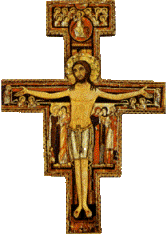
Occasionally, we speak of sensible experiences of the risen Lord. Francis of Assisi had a number of such experiences. He heard Jesus speaking to him while praying in front of the San Damiano Crucifix, 'Francis rebuild my Church which you see is falling down and in ruins'. Spiritual writers tell us that in the final stage of his conversion Francis understood the Leper he embraced and kissed to be Jesus. At the first reenactment of the manger scene, witnesses reported the Christ child came to life in the tender arms of Francis. And finally Francis had the seraphic image of Jesus before him when he received the stigmata on Mount Alvirna. Yet despite these dramatic encounters St. Francis of Assisi maintained, "I see nothing bodily of the Most High Son of God in this world except his most holy body and blood." It's this quote that is often used to demonstrate Francis's devotion to the Eucharist.

But of course a quote like this really doesn't tell us what it is that Francis 'sees'. In one sense we all see the same thing…we see the appearance of bread and wine. We of the Catholic Faith hold that at the consecration the substance of the bread and wine are changed into the substance of the body and blood of Christ [see Catechism of the Catholic Church 1374-1376]. In this consecration the bread and wine are no longer present; they have been changed into the body and blood of Christ, and yet to our senses we perceive bread and wine.

Listen to this passage from the writings of the St. Francis of Assisi, the Seraphic Saint:

Sacred Scripture tells us that the Father dwells in 'light inaccessible' (1 Tim. 6:16) and that 'God is spirit' (Jn. 4:24), and St. John adds, 'No one at any time has seen God' (Jn. 1:18). Because God is spirit he can be seen only in spirit; 'It is the spirit that gives life; the flesh profits nothing' (Jn. 6:64). But God the Son is equal to the Father and so he too can be seen only in the same way as the Father and the Holy Spirit. That is why all those were condemned who saw our Lord Jesus Christ in his humanity but did not see or believe in spirit in his divinity, that he was the true Son of God. In the same way now, all those are damned who see the sacrament of the Body of Christ which is consecrated on the altar in the form of bread and wine by the words of our Lord in the hands of the priest, and do not see or believe in spirit and in God that this is really the Most High himself who told us, This is my Body and Blood 'of the new covenant' (Mk 14: 22-24), and,' he who eats my flesh and drinks my blood has life everlasting' (Jn. 6:55).

At first glance this admonition seems disjointed because Francis begins by using Sacred Scripture to inform us that we cannot see God. Then he seamlessly transitions to lamenting the state of those who don't see or believe in the divinity of the Son of God, either in Palestine or on the altar. But if we continue Francis adds:

He shows himself to us in this sacred bread just as he once appeared to his apostles in real flesh. With their own eyes they saw only his flesh, but they believed that he was God, because they contemplated him with the eyes of the spirit. We too with our own eyes, see only bread and wine, but we must see further and firmly believe that this is his most holy Body and Blood, living and true.

Reading Francis more closely we see that if we contemplate the Eucharist with 'the eyes of the spirit' we will come to know Our Savior in the Blessed Sacrament. As we appreciate the Incarnation, the divine presence of the Son of God in his humanity, then we can truly and easily believe his promises. If we choose to live in the Spirit we will see the Lord Jesus as the divine Son of God and believe in his presence on the altar; we will hear and respond to his words "This is my Body and Blood". None of this is based on any evidence. It's based solely on faith in the Person who makes the promise.

This is why each person must seek, accept, nuture, and defend the gift that comes through his or her baptism. A gift of spiritual life in Christ, a life that enters fully into the mystery of the Trinity. Here in new life we seek 'spiritual light' and abhor darkness. Here the spiritual newborn (or reborn in the case of Confession) learns to accept in faith what is being revealed; to trust in the manner and means of salvation, and the promises that will be fulfilled in time. Thus we accept by faith that Jesus is the divine Person that the Father and the Holy Spirit testify to, and that he is doing what he said he would do, namely to feed us with his Body and Blood. This should present no problem for a Christian who dwells in light or sanctifying grace. I believe this is the crux of what St. Francis is driving at.

A sage once told me that a spiritual mystery is not a problem to be solved; rather it's a pool to dive into. When we seek to dissect spiritual mystery with words we risk confusing the reality. To enter into unending contention over the mystery of the Eucharist is to drift away from spiritual light into darkness. It's not Jesus who is hidden, indeed he is revealed by his very word and promise. His Eucharistic presence is taught and proclaimed in word and brought forth in liturgical action by his Church. It's the inner life of God that remains mysterious, though less so through the gift of sacrament. What we see, taste, chew, and feel in our encounter of the Eucharist is Jesus himself. It is what Jesus intended for us to experience as he truly unites us with himself and presents us to the Father.

The Edge is Embedded in the Core

I've always known that Franciscans sprout in all the nooks and crannies of the known world so it's good to find kindred spirits any and everywhere. Of course St. Francis is so widely admired that his followers exist passionately in both Catholic and Anglican communities. So when MikeF dropped in here at Perfect Joy, I was obligated to return the call over at The Mercy Blog; and in doing so discover a treasure trove of inspiration. Reflecting on his Franciscan vocation in a recent post he made this remark:

"I think this sense of living "on the margins", this sense that God's new word will be found out on the edges of things, is deeply embedded in the core of what it means to be a Franciscan."

I just love it when fellow bloggers drop inspirational crumbs off their table. I responded of course but this topic is so juicy that it needs an entirely new post. My comment (and this post's title) involved a charitable twisting of his remark to accommodate my insight and yet it concluded this way:

"But you're right, when [Francis] drives down into the mystical core of faith he emerges always at the margins. This is not so much being 'countercultural' or 'on the edge of things' as being freed from entanglements which he knew from experience would fasten chains around him."

There are at least two meanings contained in these remarks. The more obvious is that Franciscans look to those who are marginalized to discover God's 'new word'; that is, to hear what Our Lord is saying for our times. We're apt to find 'the wisdom from above' lacking among the comfortable, the proud, or the powerful: for them the gospel message is so often 'inaudible'. They are more likely to dispense 'conventional wisdom'; the 'wisdom of the world' spoken of in the Letter of St. James [cf. Jas 3:13-18]. This is why the followers of Francis cultivate 'the spirit of detachment' primarily through the use of penance (mortification); and also foster 'ongoing conversion' through Scripture and Sacrament.

The second meaning and the one taken up in my response is that Francis doesn't aim for the margins per se. For St. Francis the center of all of life is the Person of Jesus Christ, so to 'drive down into the mystical core of faith' is to engage Jesus. And in doing so he always emerges somehow on the 'edge of things'; more commonly called 'the margins'. He and his 'lesser brethren' have purposefully taken up the gospel in its most undiluted form; living the Beatitudes, fully and intensely; trusting in the Providence of God, wholeheartedly and without reserve. This form of life and commitment leads them away from the worn barren pathways where God's seeds are continually trodden underfoot.

For Francis the 'new word' is always fresh and inspiring. No matter what the cost of implementing some new insight, there is no concern, for he has set himself free to love and serve the Lord. The further along and the more often Francis discerns God's inspiration the greater is his delight. Whatever resistance he faces in the objection of others is quickly cast aside, because he has completely abandoned his attachments to his former way of life. He has purified his heart; a heart which now is burning intensely in love of Our Lord's Incarnation. Just as the Book of Revelation promises a New Heavens and a New Earth [cf. Rev 21], Francis can glimpse the reality of this new world even now, where all are invited through conversion into the Temple of God.

Those worldly souls who reside in the 'center of things': who have each other to rely on along with their material wealth, are in great need of conversion. Here is where the power of 'preaching by example' rises to the fore, as his life becomes an unmistakable beacon of God's love. His compassionate words, whether consolation, admonition or rebuke; along with his tender witness of love, are like divine tenderizer that softens and transforms even the most hardened heart.

To say that 'the edge is embedded in the core' is of course, a play on words--a twist and almost nonsensical. In the worldly way of seeing things 'the edge' is farthest away from 'the core'. But the gospel is full of seeming contradictions and St. Francis like no other is able to embrace them fully. So too, any followers of his spiritual path must come to embrace the hallmark virtues of minority, poverty and humility that free them from the grasp of the worldly majority. These are the spiritual ways that speak of finding Jesus on the outside of the mainstream-- 'the edge'; while simultaneously embracing Him in the core of one's life.

More by Example than by Preaching

The following passages are from St. Bonaventure's 'Major Life of St. Francis', [Part I - Chapter VIII]. They explain the reality of the Poverello's conversionary zeal and the importance he placed on witnessing an authentic Christian life before a word leaves our mouth.

Compassion, as St. Paul tells us, is all-availing, and it filled the heart of Francis and penetrated its depths to such an extent that his whole life seemed to be governed by it. It was loving compassion which united him to God in prayer and caused his transformation into Christ by sharing his sufferings. It was this which led him to devote himself humbly to his neighbor and enabled him to return to the state of primeval innocence by restoring man's harmony with the whole of creation.

The words above cannot fully convey to us what graces filled the saint's heart. Bonaventure and the other early writers often describe Francis in affective terms. We rely on external expressions of emotion, to reveal an inner reality that resides in the heart, over and above the intellect. The suffering of Christ on the cross became the 'school' in which Francis received his spiritual education. His 'knowledge' was 'compassion' and his teaching method was contained in his personal sharing of the suffering of others.

Loving compassion made him regard everything with affection but especially the souls which Jesus Christ redeemed with his precious blood. If he saw one of them being stained with sin, he grieved with such heartfelt pity that he seemed to be in travail over them continually like a mother in Christ.

What Francis learned in the 'school of the cross' was to feel the effect of sin on the sinner; not as an abstract or intellectual calculation, but rather as real loss in the way that a mother experiences the injury of her child. The Seraphic Saint 'grieves' for the sinner. For Francis, the devout Christian succors and aids the sinner as a mother does: caring and restoring health to an ailing child.

This was the principal reason why he had such respect for those who preached God's word—by their labor and zeal for the conversion of sinners and their pastoral anxiety they beget children in the name of Christ, our dear Brother who was crucified for sinners. He was convinced that such a work of mercy was more acceptable to the merciful Father than any sacrifice, particularly if it was done in a spirit of perfect charity, more by example than by preaching, more by fervent prayer than by longwinded sermons. [Emphasis added]

"Preach the gospel; if necessary use words", is a widely circulated saying attributed to St. Francis, (though he never spoke it directly). It's often reduced to a cliché uttered for consolation when Christians can't find inspiring words. But Francis was an outstanding preacher and 'preaching by example' was not a fallback for ineffective words. It was (and still is) spiritual common sense that gospel living is integral to gospel preaching. He regarded the compassionate witnessing of a good life as the instrument of conversion par excellence; as a result he deeply lamented that the grace of conversion could be assaulted by scandal and bad example.

St. Francis used to say that we should feel sorry for a preacher who sought his own glory in his work and not the good of his listeners, or who destroyed by the example of his bad life what he had accomplished by his teaching. Such a man was devoid of any true religious spirit. He maintained that an ordinary friar with no claim to eloquence was in a better position because he encouraged others to do good by his good example.

The 'ordinary friar' referred to here is not a priest but a religious penitent. The testimony of their lives stood out in shining fashion; and together with the heartfelt compassion for those who suffered, these qualities had a great effect on accomplishing the mission given to Francis by our Lord at San Damiano: 'Rebuild My Church'. This witnessing by the friars and their secular penitential associates (the third order) breathed new life into moribund souls.

He explained the phrase. "The barren womb bears many" (1 Samuel 2:5) in this way, "The barren woman is my poor friar who is not appointed to bring forth children in the Church. But at the last judgment he will bring forth many, because then the Judge will set down to his glory all those whom he is now converting to Christ by his secret prayers. 'The fruitful mother is left to languish' (ibid) means that the vain and loquacious preacher who now prides himself on those whom he imagines he has begotten by his own powers will see then that he had nothing to do with their salvation."

In this interpretation, the ordinary Christian who holds no 'office' for preaching and conversion, nonetheless has unseen powers in prayer and sacrifice; and even more power by the example of living a Christian life with love and compassion for others; with mercy and forgiveness. They receive no earthly awareness of the 'children they bring forth' into the Kingdom of God. But the Judge of us all will show us the spiritual life we have helped to pass on simply by living our gospel life fully and with heartfelt concern for others.

Picnic with Brother Bandits

(O Seraphic Father St. Francis; long has it been since I have spoken of you and your ways: forgive me. Here is a story of conversion and penance.)

How St. Francis and his 'lesser brethren' (the friars minor) won the souls of bandits by humility and charity [Mirror of Perfection - #66].

A party of bandits who used to hide in the woods and rob travelers occasionally came for food to a hermitage of the friars situated above Borgo San Sepolcro. Some friars said that it was not right to give them alms, while others did so out of compassion and urged them to repent. Meanwhile blessed Francis came to this friary, and the brothers asked him whether it was right to give them alms.

The eternal debate: Who is my neighbor? Are the criminal poor entitled to compassion? Are they suitable candidates for repentance? Some say 'yes': others complain. Enter the Poverello; what does he have to offer? He counsels kindness and compassion for the conversion of bandits: while supplying spiritual guidance for his 'lesser brethren', a path for their sanctification.

And he said to them, 'If you will do as I tell you, I trust in God that he shall win their souls. So go and bring some good bread and wine, and take it to the woods where they live. And shout to them saying, "Brother Bandits, come to us. We are friars, and are bringing you some good bread and wine!" And they will come at once. Then you must spread a cloth on the ground, place the bread and wine on it, and serve them humbly and gladly until they have eaten.

The divine absurdity: Feed the thieves; serve them gladly and with great humility. Doesn't this resemble our Lords own action? Let the cloth cover the ground as the linen covers the altar: offer good bread and wine to them.

After the meal speak to them of our Lord's words, and end by asking them for the love of God to grant your first request, which is to promise not to strike or injure anyone. For if you ask for everything at once, they will not listen to you; but because you are humble and loving they will promise this immediately.

Can this really work, Brother Francis? Will love open their twisted hearts? 'Yes of course, each time they hurt others they do more harm to themselves, though they don't see it.' 'Give them God's words – let the Holy Spirit counsel them through you.' 'You yourselves, my brothers are to be God's Word.' 'They won't see or hear their Savior and Lord Jesus, unless you carry Him within you.'

On a later day take them eggs and cheese with the bread and wine to show that you appreciate their promise, and serve them until they have eaten. And after the meal say to them, "Why do you stay here all day to die of hunger, and suffer so much hardship? And why do you do so many evil things for which you will lose your souls unless you turn to God? It is better to serve God, for He will both supply your bodily needs in this world, and save your souls at the last." Then God will move them to repentance because of the humility and charity that you have shown them.'

'We did as you said Father Francis and we ourselves were filled with the Holy Spirit.' 'When they saw that we came back with food again, and were joyful in being with them, they were moved and amazed.' 'Not only that, but they realized the foolishness of their old ways and asked if they could have our joy.'

So the friars did everything that blessed Francis had told them, and by the grace and mercy of God the bandits listened to them, and punctiliously observed all that the friars had humbly asked of them. Further, because of the friars' humility and friendship towards them, they themselves humbly began to serve the friars and carried logs up to the hermitage on their shoulders for them. At length some of the bandits entered the Order; the others confessed their crimes and did penance for their sins, laying their hands in those of the friars, and promising that henceforward they would live by their own labor and never do such things again.

They confessed and did penance. Eight hundred years have passed and those with the spirit of St. Francis continue to call out: "Brother Bandits, come to us. We are friars, and are bringing you some good bread and wine!"

Being Mothers to Our Lord Jesus

[A Rosary Meditation on the 1st Joyful Mystery - The Annunciation

"We are mothers when we carry him [Jesus] in our heart and body through divine love and a pure and sincere conscience; we give birth to him through a holy life which must give life to others by example."

-St. Francis of Assisi-

One of the greatest joys of our mortal existence is to experience the 'immanence' of God. The 'incarnation' of Christ means that which is pure 'Spirit' enters into our humanity in every way except sin. This is something that often leaves me speechless and occasionally grinning like a fool. God could have stayed 'outside' of creation: 'non-incarnate' and aloof. But He didn't. And for this I feel like St. Francis: wanting to grab two sticks and dance for joy with an imaginary fiddle.

It wouldn't hurt to occasionally ponder what having 'God incarnate' means to us as pilgrims in the temporal order. First of all, Jesus reveals how we are related to God in new terms. The Eternal Son, touches us: he becomes our 'brother', sharing with us his mother; and makes a transcendent God, our 'Father'; even 'Abba'. We share in 'his life' because he has taken on ours.

Not only that, but all of Creation can now rejoice because the Creator has revealed himself in its midst. The Canticle of the Creatures, throws new light on a sublime relationship. The sun and the moon could always give glory to their Creator, but they did so as material evidence of the Creator's work. But now because Jesus has looked upon them with his human eyes and felt the warmth on his human skin, they become 'transformed', if you will, with all of Creation. All of Creation 'praises' the 'eternal God' through Jesus. All in Creation are related to each other as kin, through Jesus.

Mary's role in all of this is the basis for St. Francis' undying devotion to her. The early writers say The Poverello loved her with what is called 'inexpressible love'. Her loving reply, 'be it done unto me according to thy word', is the indispensable cooperation of Mary for the human family. She is the gateway to incarnation of the divine Person of Jesus. Indeed, all generations will call her 'Blessed'.

When reflecting upon the 1st Joyful Mystery of the Rosary I find myself enthralled, even now, in anticipation of the young Virgin's response. Oh what a glorious encounter in our salvation history. I must confess that in the past I've regarded Mary's 'fiat' passively; not understanding both the loftiness and humility of the drama spanning the eternal and the temporal.

By loftiness I'm referring to the sheer magnitude of what is at stake, and the high measure that God uses to choose his Son's mother. The high measure being her lowliness: her humility brought about by her complete openness and cooperation with the singular graces given her.

Though we haven't received her singular graces, nevertheless, Our Heavenly Father, in his providence provides in each and every way, what we need to accomplish his will for us. So in recalling the refrain of St. Francis stated above, we should count on the Holy Spirit and also Mary, as being midwife and model, in bringing about the 'birth' of Jesus in ourselves. To 'carry Jesus in our hearts and body' and to have him 'give life to others by our example' means necessarily our own dying to ourselves. This is of course the sticking point: the need to accept a baptism of death to our worldly way of life; and a rising to new life in Christ Jesus.

God can move deeply into our lives: but not without our consent. Our Heavenly Father has chosen us for something special, to carry His Son and to reveal Him to others. And if a thousand billion others are called to the very same task it still is glorious to undertake. I'm speaking of course of the awesome task of being 'mother to our Lord Jesus Christ'.

________________________

The More We Renounce Ourselves…

In recent posts we saw how 'Penance Must Precede Peace'; and argued for 'Reclaiming the Practice of Penance as Virtue'. This reflection will consider the individual's response to the 'call to do penance': the battle of 'me' with 'my self'. As we observe the exaltation of the 'self', promoted with reckless abandon in every aspect of our culture we need to take a serious look to see whether we've been lulled into complacency. The best method I know to keep us on the right path spiritually is to 'do penance'.

Our goal here is to promote the value of 'doing penance' and to suggest a way to begin the process. Those who would even consider this already know that penance is not something new, but a reclaiming of something that is ancient, proven and truly radical. This is the penance done in secret that Jesus spoke of when he said, 'wash your face and smile so no one knows that you are fasting'. [cf. Mt. 6:16-18] What the penitent does our heavenly Father sees.

Let's briefly review three issues: (1) Obtaining the desire to do penance; (2) Focusing on a particular behavior or attitude to amend; (3) Choosing a suitable penance to perform.

The first consideration for the individual is obtaining the desire to 'do penance'; which is itself a gift from the Holy Spirit. Doing penance is not a natural inclination. I confess it's simply not for me to know how this desire breaks to the surface. To think or utter, 'Lord, give me the spirit of penance', signals the process is already underway. So we should give thanks for the desire itself. All Franciscans have a duty to somehow cultivate this desire and regard it as an indispensable virtue. We will desire penance more as we discern its value.

The value of this 'gift of penance' becomes obvious when we consider the following scriptural passage. As you read, keep in mind the 'Prologue' to our Rule regarding those who 'do' and 'do not' do penance.

"What human nature does is quite plain. It shows itself in immoral, filthy, and indecent actions; in worship of idols and witchcraft. People become enemies and they fight; they become jealous, angry, and ambitious. They separate into parties and groups; they are envious, get drunk, have orgies, and do other things like these. I warn you now as I have before: those who do these things will not possess the Kingdom of God.

"But the Spirit produces love, joy, peace, patience, kindness, goodness, faithfulness, humility, and self-control…And those who belong to Christ Jesus have put to death their human nature with all its passions and desires. The Spirit has given us life; he must also control our lives." [Galatians 5: 19-25]

"The more we renounce ourselves, the more we walk by the Spirit", says the Catechism [cf. CCC 736]. That is the understanding that St. Francis preached. Regarding those who do penance, he said: 'The spirit of the Lord will rest upon them, and he will make his home and dwelling among them'.

[If you've read this far, rejoice: you've been called to do penance!]

The second consideration is to ask, 'What specific behavior or attitude needs reforming?' While the scriptural passage above speaks to 'human nature', this needs to be owned by each of us, concretely. The point is that each of us, as individuals, ought to assess what behavior or trait has us crawling on our belly when we should be standing upright. A good spiritual director or valued confidant would be helpful. Again, here we're not considering the repentance of 'humanity', 'human nature', or 'the flesh'; but rather oneself and one's own individual behavior.

A useful indicator of where to apply 'the practice of penance' concretely, is where we experience the opposite of the 'fruits' mentioned above: for instance, feelings of bitterness instead of love; despair instead of joy; or anxiety vs. peace. These are red flags that shout for scrutiny and action.

Also keep in mind; these previously mentioned 'nine fruits of the Holy Spirit' (love, joy, peace, etc.) are inseparable. It's no accident that when we experience a lack of 'self control', for example, that all of the other 'fruits' dissipate. This realization helps to strip away some of the most insidious self-deceptions: (i.e., the feeling of being 'in love' with someone, without 'joy or peace': or regarding myself as 'humble' with others, when I lack 'patience'). The insight of St. Francis in his Salutation of the Virtues is just as valid here: "Whoever possesses one and does not offend the others possesses all, and whoever offends one does not possess any and offends all."

The third matter is choosing a suitable penance to counter the malady. Prayer, fasting and almsgiving are ancient and unquestionable weapons for spiritual combat. Consider adapting and expanding them generically to get into the real issues you face. 'Fasting' implies sacrifice. It could mean denying oneself of anything that is licit and pleasing but somehow detracts from one's relation with God. A good example might be turning off media and turning on prayer and spending time with those in need. Find out whether it is harder to give up meat or your favorite TV show (and ask, 'why'?). Be open and creative: seek specific results of changed behaviors and attitudes.

Here's sage advice: if your 'penance' makes you irritable or cranky with others…stop and realize…'there's no fruit here'. Don't give up: just pray for guidance and either adapt or try again.

Lastly, I purposefully left out a different dimension of 'penance'. Our liturgical forms or penance as a people ; (i.e. Ash Wednesday and Lent; Fridays as a day of penance; fasting for justice; etc.). This has social significance in fostering repentance, instilling justice, and creating unity for the 'People of God' as a whole. I'll take up the communal aspects of penance in a future post.

Reclaiming Penance as Virtue

These days one rarely hears about the practice of 'doing penance'. Its value is belittled. Its necessity is questioned. Its effectiveness is ignored. Yet St. Francis placed the highest importance on 'doing penance' and preached it as indispensable in the spiritual life.

One interesting and helpful insight into how Francis judged the matter is noted in Legend of Perugia: [cf. #96 – Brother Body]. To paraphrase Francis: The body is meant to serve God but can easily be impeded or distracted. This is the devil's playground. In matters of '…food, sleep and other necessities, the servant of God must act with discretion so that Brother Body has no excuse to complain' (i.e., we should avoid being unjust to our bodies). He continues… if on the other hand the body gets what it needs while observing moderation, and yet responds by '…being lazy, negligent, sleepy during prayers, vigils and other good works, then it must be chastised like a bad tempered and lazy beast of burden that wants to eat, but refuses to carry its burden.'

From this we can see that 'Brother Body' is called to glorify God. The body is 'weak and fallen' yet eternally destined to share in the joy of eternal life. Penance as mortification is indeed a virtue if it serves to move us (as it should) in the right direction and keep us on the path to God. Any other 'chastisement' can quickly descend to a misguided endeavor and defeat the goal of serving God joyfully. Of course it doesn't help when the virtue is itself distorted by bad practice. It is meaningless when deprived of the vital elements of love and contrition: of heartfelt sorrow for one's sins (not sin in general but my sins in particular).

The Church has clung to the practice of penance insistently, providing seasons and days for its observance. We see scriptural evidence of the 'People of God' often being called to prayer and fasting as a measure to correct waywardness and counter the influences of the surrounding culture. We can't ignore how our current culture of consumerism and materialism has launched a frontal assault on anything remotely resembling the practice of 'doing penance'. Contemporary opinion of the practice is often seen as unnecessary and ludicrous; outdated and old fashioned; even backward and harmful. Yet, when the practice of 'doing penance' is put into actual usage, it quickly loses its absurdity and induces a sense of wisdom and good judgment.

It's not for me to judge how God may inspire any other individual to carry out the practice of penance. What I can judge however, is my own response (or lack of response) to what is certainly a tried and true virtue. Something to consider is the effect that the original lay followers had on St. Francis. The Brothers and Sisters of Penance were fervent practitioners of penance. St. Bonaventure notes that they received great inspiration from Francis which in turn inspired him to practice the virtue to a 'heroic degree.' [cf. Major Life of St. Francis; Chapter V, 1]

Penance as sacrifice or mortification; when aligned correctly in a spirit of love and contrition will undoubtedly fly in the direction of God. Even if the penances are 'soft': when launched with a 'humble and contrite heart'- the angels will gather them and deliver them to the hearts of Jesus and Mary, where they will be used for God's own divine purposes.

Still not convinced of the benefits of this virtue? All I can say is that this is one area where practice trumps knowledge. This brings us to another Franciscan trait: the habit of doing virtue rather than merely pondering it. As the Seraphic Saint said, "I would rather feel compunction than study its definition."

"Let us begin anew, for as yet we have done nothing."

Penance Must Precede Peace

Reflection upon a few paragraphs from Mirror of Christ: Francis of Assisi, by Isidore O'Brien, O.F.M.; St. Anthony's Guild, Paterson, NJ; 1944 [Pgs. 157-158]

He [Francis] who lived so completely the Gospel realized with a clarity grasped by so few the evangelical truth that penance, sincere and strong, must precede peace, as the needle must precede the thread.

The above observation uses an unusually keen image to explain one of the principles of Francis with brilliance. It is so perceptive that we should devote special attention to its meaning and its guidance.

Francis possesses a deep appreciation for the consequence of 'our fallen nature'; the effects of sin and the resulting chaos that distorts all our relations. He preaches penance as the way to 'restore order', which is ultimately what we mean when we speak of 'building peace'. Stated another way, 'peace' is a reflection of our harmony with God. St. Augustine called this 'the tranquility of right order; and a necessary precondition for this state is a change in heart, or repentance. This opens the way for peace.

Francis saw clearly: sin had thrown the whole moral world out of balance; only the practice of penance and co-operation with grace could restore that balance for the individual and the world; only in that balance would men find peace. Therefore he preached penance…

The great announcement of the Gospel is not 'Listen and believe the Good News.' It is clearly 'Repent and believe the Good News.' [Mark 1:15] Repentance begins by acknowledging that we have offended God which results in discord; and subsequently, accepting the 'right order' of God's way - which has among its fruit, 'peace'. Of course, the change we call repentance, is not a one time act. The Seraphic Saint preached that conversion was daily and ongoing. It is strengthened and renewed in daily penitential practices which are vital for those who would bring about peace.

One of the chief goals of doing penance is to draw attention to what is most important and to strip away deceptions and pretexts that hide truth. This invariably involves the difficult process of dying to oneself and overcoming selfishness. Francis describes the Penitent in this way; as one who…'loves the Lord with their whole soul and mind and strength, and love their neighbors as themselves, and hate their bodies with their vices and sins…and produce worthy fruits of penance.'

'Hating one's body with its vices and sin', is to detest whatever it is in our 'fallen state' that causes us to reject God; and as an antidote, to take up the life of penance with the help of grace, to reestablish harmony with God. The penitential life is a sacrificial life: a life in which everything is viewed and judged in the light of God. Priorities are modified or reversed, while simultaneously, trust in 'Abba' our loving Father is strengthened. Peace is gathered as a harvest. Life is nourished in Peace.

… and one on the chief fruits of his preaching was the formation of the Order of Penitents, [The Third Order]: an institution that brought peace to individuals and cities and communities and even to nations...

The Catechism tells us that…'Respect for and development of human life requires peace' [CCC 2304]. It's this characteristic that demands our steadfast commitment and labor. How will we, as today's enlistment in the 'Order of Penitents', account for our time and effort in building peace? Peace as saving ointment and healing balm, (as opposed to faithless 'peacemaking' bombs), for the rest of the world.

To seek political or temporal peace is certainly one of Francis' legacies. Yet it understates what is called for in our vocation as peacemakers. To reveal to fellow human beings the beauty of Peace as 'harmony with God', (and therefore each other and Creation), is the highest form of peacemaking. Those who can see clearly what St. Francis saw, namely the relation between penance and peace; will be delighted to put that insight into practice.

Reading the Prologue to our Rule and connecting 'peace' with what it means to 'do penance' and 'not do penance', will open our hearts and help us to shun chaos and restore right order. "Oh, how happy and blessed are these men and women when they do these things and persevere in doing them because 'the spirit of the Lord will rest upon them' and he will 'make his home and dwelling among them'…"

True Penitents are not glum and their call is never outdated. They are in great demand. They bring something essential to the world: God's Peace.

I Need Another Ladder

Holy Virgin Mary, there is none like you born in the world among women, You are daughter and handmaid of the most high King, our heavenly Father, You are mother of our most holy Lord, Jesus Christ, You are spouse of the Holy Spirit. Pray for us, With St. Michael the Archangel, All the virtues of heaven and all the saints, To your most holy, beloved Son, Our Lord Jesus Christ. Amen __________________________

I am grateful for having discovered this beautiful praise to Our Lady nearly twenty years ago. St. Francis recited this antiphon at each of the hours in his 'Office of the Passion', which he said daily, in addition to The Divine Office.

It is said Francis loved Mary with 'inexpressible love'. He was overwhelmed with the wonder of Our Lord's 'Incarnation', which was accomplished through Mary with her fiat: and for this he praised her unceasingly. Knowing of The Poverello's fondness for, and continuous use of this antiphon, I decided long ago to make it part of my daily recitation of The Divine Office. I simply replaced the hymn, with the devotional antiphon when reciting the Office in private. For me, it is a favorite prayer to honor Mary.

I experience the heart of this prayer, as highlighting Mary's relation to the Triune God. She 'lives, moves, and has her being' as: daughter of the Father; mother of the Son; and spouse of the Holy Spirit. The antiphon inspires us to meditate on her relationship with each Person in the Blessed Trinity, which in turn, serves to illuminate our understanding of the mystery.

She is enthroned in complete and perfect relation to Father, Son, and Holy Spirit: and is poised therefore, to be the perfect intercessor for us. Mary as our helper is 'the splendid woman' who cooperated fully with grace and thus reveals our potential as creatures to be filled with God's love.

In a dream, Brother Leo, a companion to St. Francis, had a vision about the preparation of the Last Judgment. In it he saw a red ladder extended from the earth to Heaven with Our Lord at the top. Next to him was Francis encouraging his brothers to climb; yet as they ascended they would fall off to the ground. Francis turned to Jesus who in turn revealed His Wounds, all bleeding, and said: "Your friars have done this to Me." Francis looked over to see a white ladder and yelled to the brethren…'run to the white ladder…that is the Holy Virgin's ladder'. They were easily able to climb the other ladder. [cf. Little Flowers of St. Francis (Fioretti), Part III, Chapter 19]

Who better to turn to, when we're burdened by anything which distances us from God? Does God the Father, seem too harsh or unfair? Look to the daughter to soothe your anxiety. Does the Holy Spirit seem stingy with his gifts? Turn to Mary; she will share what her Spouse has given her. Does the Son demand more faith than can be mustered up? Tell this to his mother, she will obtain more faith for you.

Our Lady is proclaimed Protectress and Advocate for the Franciscan family by the Seraphic Saint. Not only for the needs of the 'Order' as a whole, but for each and every member personally. Therefore, she should be called upon often and fervently for any aid. She has unfailingly provided the easier ladder for me when I needed it. Consider inserting Francis' beloved antiphon somewhere in your daily prayer.

Don’t Soak the Beans ‘til Tomorrow

Mirror of Perfection - Chapter 19 - How he did not wish the friars to be provident and anxious for tomorrow.

"He therefore forbade the friar who cooked for the brethren to put dried beans into warm water in the evening, as is usual, when he intended to give them to the friars to eat on the following day. This was in order to observe the saying of the holy Gospel, "Do not fret over tomorrow".

__________________________________________

While the manner of soaking beans is unimportant, the awareness of the providence of God is vital to a life in union with Him. Francis knew this, and as the guide for his Lesser Brethren he was inspired to train them.

Some of us feel the need to have much of the future well planned. Since God doesn't reveal our future we take matters into our own hands. To some extent this is one aspect of the virtue of prudence. But as we expend excessive time and energy for the future we take away from the present with its own inspirations and demands. We can become as time travelers venturing off to the land of our future fears and anxieties; distracted from God's love and care for us right now.

Shortly before writing this I began reading a book on reconciliation and healing. In the first few pages was posed a certain reflection: Do I question God's providence - mistrust him - doubt him? When phrased like this it does point to the heart of the matter, namely: How much does God really care for me? How actively and attentively is He involved in my life?

One factor which will determine our response is the amount of time spent in prayer. Considering that prayer is communication with God, we might inquire, what level of dialogue is going on? For example, if my adult children are living in another city I might hear from them often, over the phone, pouring a weeks activity into a half hour chat. On the other hand, they might be estranged from my life, in which case I only hear of them through others or when they're really desperate for help. Communicating with God implies trusting Him.

If my trust in God's providence is lacking, this calls for healing. The Sacrament of Reconciliation is the privileged place to bring this wound. The Triune God who creates and sustains...provides. Materially, He provides according to our needs; and spiritually, full measure flowing over.

The essence of love is in the desiring of what is good for the other, the beloved. Trusting in that love; assured of its performance without slack or fault is the greatest sign of faith. It's always refreshing, sometimes surprising and ever delightful to have God provide. This is what Francis wanted the friars (and all his followers) to experience. So then…don't soak the beans 'til tomorrow!

Prayer: Father, how wonderful your care for us!

The Opportunity of a Humiliation

We Will Not Have You Govern Us For You Are Too Unlearned [see 2 Celano145b; Legend of Perugia 83; Mirror of Perfection 64]

In the everyday world people are lauded for their ability to 'seize an opportunity and profit from it'. It's most remarkable when the opportunity is there for everyone, yet somehow the vast majority overlooks it. Ultimately, someone recognizes an option which others haven't discovered and turns it into profit. Would you account a humiliation as an opportunity for gain? Francis did.

In his description of a 'True Friar Minor', Francis uses an illustration of himself being criticized and removed from office in the Order because…"you have no eloquence, you are simple and unlettered." He continues, "At length I am thrown out with reproaches and despised by all. I say to you unless I listen to these words [of humiliation] with the same face, with the same joy, with the same purpose of sanctity,[as words of praise], I am in no way a Friar Minor." And he added: "In an office is found an occasion for a fall; in praise, an occasion for complete destruction; in the humility of being a subject, an occasion for profit for the soul. Why then do we pay more attention to the dangers than to the profit, when we have time to gain profit?

In pointing out the dangers of praise and the profit in humiliation the Poor One of Assisi is guiding his followers up the mountain of sanctity and perfection. If we wish to follow him on this assent we have to accept our humiliations as gains; for under grace, that is truly what they are.

For our purposes let's say that humiliations come in two general forms. The first are those which we inflict upon ourselves. We might call this, "making a fool of myself", usually caused by poor judgment or foolish behavior. Often in this circumstance there is no spiritual gain, because we're generally not aware of what's happening or why. But if there is awareness, then the opportunity for gain will follow.

The second form of humiliation comes from others and is more of an injustice; often brought upon by some misunderstanding or confusion. Or perhaps a judgment that's different than ours. Even the lowliness of our position, our lack of power or rights, places us at a disadvantage. We feel the humiliation deeply and our first inclination is to react emotionally; to defend ourselves. But wait, this is where Francis says…'I see an opportunity for profit'.

We read in scripture: God opposes the proud, but gives grace to the humble (Jas 4:6). Yet often it seems that even among those interested in the spiritual life; that to act humbly is separate from enduring a humiliation. The sense that justice may be lacking causes the wounded soul to want to defend and fight back: if my humiliation is caused by someone else's detraction of me...then what? Am I not entitled to my reputation? And even if I do bear some fault, should I not be treated more charitably?

But what might Francis whisper? "I say to you unless I listen to these words [of humiliation] with the same face, with the same joy, with the same purpose of sanctity [as praise], I am in no way a Friar Minor."

Do you think that this is unique to the Franciscan way? Consider the Church's teaching on Indulgences, updated and revised in 1968. In the First General Grant we read: "A partial indulgence is granted to the faithful who, in the performance of their duties and in bearing the trials of life, raise their mind with humble confidence to God, adding—even if only mentally—some pious invocation." Are not humiliations, prime fodder for this source of grace?

Again in the Third General Grant: "A partial indulgence is granted to the faithful, who in the spirit of penance deprive themselves of what is licit and pleasing to them." That justice that I didn't receive—that justice that was lacking, yet licit and pleasing to me—can't this be given up in the spirit of penance? Is it any wonder that the poor Francis, affectionately known as the Poverello, was the richest man on the face of the earth?

The Leper Heals Francis

An excerpt and reflection from an out of print biography: Some Loves of the Seraphic Saint, by Fr. Augustine, OFM Cap.; Published in 1944; M.H. Gill and Son, Ltd., Dublin; Pgs 29-31.

In describing the conversion process of Francis, Fr. Augustine speaks of various encounters that he had to overcome. The first he called the visible enemies, the second, invisible foes, and the third...the greatest foe of all--himself. This final encounter refers to his own attitude and feelings about people that he feared intensely...lepers. The biographer tells us that Francis' revulsion was surprising; note the reason why.

"Before his conversion, the lepers had always inspired him with disgust. Even the sight of one in the distance filled him with horror and dread. He would never give them alms directly, but always through an intermediary. A hospital especially devoted to their care stood on the plain in the vicinity of Assisi, and whenever he went in this direction on business or for pleasure, to escape the nauseating odor…he hurried past with averted and closed nostrils. This is all the stranger when we remember that the leper inspired great veneration in these ages of Faith. The reason of this veneration was that the Prophet Isaiah represented the future Messiah as a leper struck by God and humiliated. [cf. Is 53 –The Suffering Servant]. Hence the lepers more than all other sufferers were looked upon as an image of the Redeemer, and spoken of tenderly as "the poor of the good God" and "the sick ones of the good God." Christ himself, too, during the days of His mortal life, had great compassion on the lepers, and never closed His ears to their appeals for cure. Legend had also consecrated stories of lepers being changed into Jesus himself in the arms of their benefactors. In spite of all this, however, Francis could not overcome the natural repugnance which the very sight of one excited in him."

The sight of someone radically deformed, disfigured or diseased can cause an emotional response that is extreme and repulsive. Some deep seated fear of the afflicted person; their pain, misery, and alienation; touches us and we naturally look to run away. It's akin to the fear of death, and in some sense perhaps, worse. Whatever is in Francis that must be purified, is holding him back. It's the last battle, so to speak, before he becomes entirely available for God's work.

"But the Lord was leading him by the hand and slowly purifying his sensitive nature. One day as he was riding across the plain below Assisi absorbed in thought, his horse suddenly swerved a little, and, looking up, Francis saw a leper before him asking for alms. His whole soul sickened at the sight, and his first inclination was to cast some coin on the ground, spur his horse and ride away. But he reproached himself in stern tones: "Thou art not yet a knight of Christ if thou canst not conquer thyself."

Francis is aware of the battle struggling within and laments his failure. It is well for us to stop and consider how these terrible moments which we dread, are so vital for us to overcome on our journey toward The Kingdom. If we could only remember to cry out: "God, come to my assistance; Lord, make haste to help." Yet God did come to his assistance.

"The vision in the cave rose up before him, and he saw the figure of the wounded, bleeding Christ reflected in the leper. A wave of pity, compassionate love passed over his heart, and reining in his horse, he leaped down, ran back to the poor sufferer, placed a generous sum of money in his wasted hand, and then, raising it reverently to his lips, kissed it. Before the leper could utter a word Francis had clasped him in his arms, and received, in turn, the kiss of peace from the poor stricken one of the good God. Having borne away the prize in the third encounter, Francis felt that he was now a true knight of Christ."

Francis plunges into the mystery that God works even through suffering to accomplish his will. The leper becomes God's instrument of healing--to Francis; allowing the Divine Person to pour through and dissipate the fear and revulsion that had occupied his heart.