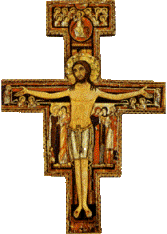
One of the reasons I love the Franciscan way of life is its willing acceptance of the paradoxes of Christian life. Followers of Francis have that seemingly odd spiritual sense of embracing what the world finds absurd. It's a quality of finding what you're not looking for by searching for the wrong thing. For instance, striving to become the leader and discovering that a true leader is really the servant of all the rest. We grow by becoming small, rather than lording it over others. We receive by giving, not taking. We discover a rich life through spiritual poverty or we find true greatness in holy humility. (Note: I count this uncommon quality as an authentic sign of a Franciscan vocation; conversely someone who resists this inclination is applying at the wrong door.)
Of course Franciscans don't own this quality, it's basic to Christian spirituality; but it is a hallmark of our spiritual family. Other paradoxical traits include simplicity and pardon. Simplicity disarms cunning and overcomes worldly wisdom (which is really foolishness). Forgiveness and love have the power to sting a wrongdoer and may ultimately transform a heart to goodness (see Article XIX of the SFO Rule). To follow Francis is to necessarily enjoy the paradox of finding our strength (which comes from God), in our weakness.
This quality is heralded in The Prayer of St. Francis: (an excerpt)
For it is in giving that we receive,
It is in pardoning that we are pardoned,
And it is in dying that we are born to eternal life.
We could easily misunderstand or limit our understanding of the above passage. We might conclude that when we give, we begin a chain reaction that results in our receiving something in return. This is the world's rationale. Or again, when we pardon, we're setting a good example, and therefore we might hope it will be contagious and spark a return. Indeed, sometimes this is the case. Nevertheless, whether we receive anything back, or are pardoned in return, is actually irrelevant to the greater good of uniting with the Will of God.
Sadly, our experience teaches us that our gifts are often spurned and our forgiveness is usually trodden underfoot. As bad as that seems it gets worse, because we foolishly translate this into disappointment in others, and sometimes in God. We often judge our own uncharitable ways as justified, because we gave but did not receive in return. But here in the world's disappointing behavior St Francis finds an inverse response to the situation; he shows us joy, something Francis referred to as 'Perfect Joy'. (If you're unfamiliar with 'Perfect Joy', click here.)
What the Prayer of St. Francis says to me is that when we give of ourselves, we do as God has shown us in the giving of his Son Jesus; and we simultaneously receive the gift of the Son. When we pardon from our hearts unconditionally; we pardon others in the manner God has pardoned us; and in doing so, we receive our own eternal pardon. Finally, and perhaps most paradoxical, we must hasten our death to our own unhealthy inclinations. When we're ready to immerse ourselves in a baptism of death to the old man, only then are we ready to rise to new and glorious life.
For those of us who are professed into the Order, we have the responsibility to live out these inverse qualities of poverty, humility, simplicity, chastity and all the rest, in manner appropriate to our state in life. In doing so to make it clear that Jesus is present in us and to not obscure his image in any way. If we fail to show this life we're squandering precious time (Mea Culpa).
It is in Giving that We Receive


The Primordial Relationship
The essence of religion is the relation of man beyond himself to the unknown reality that faith calls God. It is man's capacity to go beyond all tangible, measurable reality and to enter into this primordial relation. Man lives in relationships, and the ultimate goodness of his life depends on the rightness of his essential relationships—I mean father, mother, brother and sister, and so forth—the basic relationships that are inscribed in his being. But none of these relationships can be right if the first relationship, the relationship with God, is not right. This relationship itself, I would say, is, properly speaking, the content of religion.
(Joseph Cardinal Ratzinger – Salt of the Earth)
The above is an insightful response to a question many have regarding the essence of religion. What I find interesting is the awareness of proper ordering of relationships; that it's in discovering and giving priority to the relationship with God which guides and nurtures all other relationships successfully. Even if we allow for the fact that many people discover this 'Primordial Relationship' through other relations; we must still conclude that the proper disposition of our relationship with God (it's rightness) is what enables us to get the other relationships 'right'.
In religious terms this means placing our relationship with God first and above all others. The skeptical world views this as a scandal, because it falsely interprets this to mean interference, or worse, a degradation of the natural movement of human affairs. Scriptural passages which focus our love, obedience and attention to our Creator, sometimes appear overbearing to the nonbeliever and confusing to the novice believer.
The danger here is twofold. On the one hand we can form rigid notions of religion in which we view it as a set of preset instructions or commands and fail to participate in a real manner of listening and responding to what God is directing us to in our unique mission. On the other hand, we can ignore the parameters of this 'primordial relationship', created for our own good and the good of others, and instead create foolish and destructive patterns of behavior that appear fulfilling and loving while distracting us from getting our relationships 'right'.
I'm somewhat concerned that so many have entered into these 'other relationships' (family and beyond) without the proper footing that comes from recognizing and developing the 'primordial relationship'--communion with God. Societies are struggling and families failing because they lack the connection and guidance of that supernatural relation to God. The overarching role of religion in our lives is to correctly form the 'primordial relation', which can then be relied upon to form all other relations 'rightly'; with true love, integrity, justice and compassion.
So true religion has the fearful task of calling individuals to the 'primordial relationship'; and beyond this it also has the task of informing and shaping that relationship. To complicate matters it has to do so in a contentious arena where a host of voices clamor for attention and legitimacy. In all of this the individual must respond, not because of coercion or power, but because he or she is created for the purpose of living in this relationship and in communion with others. The faith involved is not for the purpose of making life easy but for the purpose of making life real.
"Man lives in relationships, and
the ultimate goodness of his life depends on the rightness of his essential relationships." Indeed, this is a crucial test of goodness not to be underestimated. The 'rightness' of our relations grows from family outwards to the fraternity of all mankind, especially those in need. So getting it 'right' seems to be of paramount importance. "But none of these relationships can be right if the first relationship, the relationship with God, is not right."
What Is God Whispering To You?
And the Holy Spirit did in fact put wind in Pope Benedict's sails as you could see the acuity in his eyes, hear the confidence in his voice, and easily discern the true love for Jesus in his heart. He warned us of evil, but assured us of our triumph. He mapped out the various pitfalls we must overcome and gave us the guidance in rough terrain. He directed us to pray and revealed the need for silence: to listen and be touched by God.
Can a few pages be a catechism? It seems so. This document demands attention,  Now that's a provocative question. The Holy Father asked this and other probing questions to his audience at St. Joseph's Seminary. It was certainly inspirational to those poised to meet the Church's future. At that moment they experienced the presence of the Holy Spirit and his gifts being poured out in superabundance. Too rich a fare to be digested quickly, the pontiff's remarks were something which needed to be captured and pondered. I was fully amazed at the scope of his speech which surveyed quite a bit of ground; it was a lavish display of the good shepherd's loving guidance for his young flock. Shepherd, father, professor, and prayer director: he was all of these in a spectacular display of the Holy Spirit's power.
 prayerful reflection, and application. As these young people will eventually discover; what takes only a few minutes to read will involve a lifetime of transformation. Guided by the Holy Spirit, they will realize that an address that took only a short time to deliver, required the better part of eighty-one years to compose.
Confessions of a Liturgical Pray-er
In roaming the Catholic blogosphere I've discovered a lot of discussion among lay folk concerning a form of prayer called 'The Liturgy of the Hours' or 'The Divine Office'. I'm presuming that you have a general knowledge of what this form of prayer is. There are many very fine websites devoted to this topic. Click here for an very detailed online tutorial.
I've listened through posts and comments as many have described the travails they've experienced in trying to sustain The Divine Office. Many have tried and quickly given up. Others have continued for a time and have been overwhelmed by its demands and had to quit. I want to make some comments on what it is that has helped me to sustain my commitment in praying the Divine Office for over two decades. Hopefully, someone will get some helpful tips on how to approach this as a layperson.
In addition to my own personal experience, I have been helping others to discern if this prayer is for them, as well as giving some guidance on its implementation. This has been primarily through my role in Fraternity Life as a Secular Franciscan. I have been Minister, Council member or Formation Director for the majority of those years and this is one topic that each and every member must address.
So why do so many lay people start with good intentions and quickly fall away? Here are a few reasons that I'd like to point out and then explore:
Liturgical Prayer as Prayer of the Church: The Divine Office is liturgical and not personal prayer, even when said alone or in private. The root meaning of 'liturgy' or an 'office' is something akin to 'a public work' or a 'duty'. Someone who has fallen away from regular Sunday mass attendance is apt to make a comment such as: "I don't get anything out of the mass". Such a remark will trigger a vignette playing in my head that sounds something like this: 'I'm sorry if you don't get anything out of this. This is not about our personal religious experience but rather about our praying WITH and FOR the 'Body of Christ'. This individual has confused the 'public work or duty of liturgy' with their own personal prayer experience.
To use a military analogy, if a young person joins the Army because he wants 'to be all he can be'; well that's fine. But ultimately he or she will come to understand that the goal of their personal development will take a back seat to the overall mission of the Army itself. They are really being asked to participate in a larger mission that could ultimately involve the sacrifice of their lives. Indeed, 'personal development' can and does happen, but this is due to the fact that the soldier is maturing and participating more fully in the larger mission.
And so it is with our participation in any form of liturgy. Hence, the reality of liturgical prayer is that it is the prayer of the Church; not our personal prayer.
Insufficient Personal Prayer Life: Like our unprepared person who 'gets nothing out of Mass': someone who has little or no devotional or prayer life will find it difficult to jump into The Liturgy of the Hours. They are not likely to bear the burden or sacrifice, small as it is, because they haven't formed a mature sense of who Christ is and the mission he has established for his Church. I think this is true for all liturgical prayers: The Mass, Benediction and Eucharistic Adoration, The Divine Office. Each of these liturgical forms of prayer flourishes when the individual 'brings to them' some personal experience in meditation, scripture reading, or other form of private prayer. The disciple moves from being an observer to one who now wants to 'get yoked' with the Lord.
Excessive Rigor and Scrupulous Rubrics: In short, lay people sometimes overstep the mark by transforming their home, a 'Domestic Church', into a 'Domestic Monastery'. [I am speaking here specifically to the lay individual who is participating in private recitation of the Office. Certainly any Religious or Priest is answerable to their own vows, spiritual guidance and/or Religious Superior.] The secular person's life, especially with marriage and family, has huge demands and duties in and of itself. Our response to these demands is where much of our holiness and sanctity is being formed.
These family roles are our true vocation and duties and they rise even above our desire to participate in the liturgical form of prayer. Since the needs of the family are so great the demands of The Divine Office must occasionally yield to the legitimate demands of the family members. All of this is to say that the lay person who frets over missing an occasional prayer session or is not able to say prayers when and how he or she wants, is causing excess burden upon themselves and therefore increasing the chance that the entire undertaking will be dropped.
Freely for the Love of Jesus and his Church: Sadly, some people do Sunday mass liturgy because they 'fear hell' if they don't. Others respond to a sense of obligation. But love of Jesus and his Church is the greatest motivator and that's the only reason to take up this liturgical form of prayer. Finally, be wary of making commitments such as 'I'm doing this for the rest of my life' without due consideration. I find that lay people do best by practicing this prayer freely until they arrive at the point where 'missing the prayer' hurts. Then they will discover they have been 'called to the liturgy'. [Note: Professed Seculars such as myself have in fact made 'promises', but not vows and thus should strive to do what they have promised on the day of their public profession.]
Afterthoughts: Should we pray the one volume – the four volume set – some subscription format like 'Magnificat' – or a shortened version like Little Office of the BVM? Yes, yes, yes, yes…whatever works for you. I use the one volume edition called 'Christian Prayer'. (It's old and soft like a broken in baseball glove.) I feel entirely free to sit relaxed with a cup of coffee or even a glass of wine in the evening and participate in the Liturgy of the Hours. My morning prayer can be anytime from wake up to mid-afternoon. My evening prayer is anytime from late afternoon until bedtime. I try to find a quiet place to pray. This could drive me from room to room depending on where others are. My favorite place is outside in the yard when the weather cooperates.
Morning prayers are easiest as I now have the luxury of 7 am mass followed by rosary with the 'rosary ladies' followed by The Divine Office in front of the Blessed Sacrament, followed by a few quiet moments alone with the Lord. This is the ideal of course and is only a recent development in the last year. If my schedule changes I'll have to give it up. Ironically, if I do miss an occasional Office it's most likely to be Sunday morning when the whole routine is changed and others are running around. So go figure.
Oh, one more thing. If you really want to see the fruit of this manner of prayer in Franciscan flavor, take a look at this short Breviary meditation by clicking here.
Finding Your Spiritual Family
Let me begin by introducing "Paths to Renewal: The Spirituality of Six Religious Founders", by Zachary Grant, OFM Cap.,(Alba House, Publisher - 1997). I attended retreats he gave for lay Franciscans at a period in which the book was in its final stages and therefore acquired a genuine interest in his perspective. Rev. Grant reflected upon, researched and studied this topic for many years. He polled many representatives of the various religious orders and congregations to get their input. This is the source that I am relying upon to bring out issues that I alone am simply not qualified to explain.
In my previous post I remarked that…'as a useful matter...to know which spiritual family you fall into will propel your spiritual life'. I have found that to be true in my own experience; so much so that I hope to explain it in a way that will convince you to pursue the matter.
Though Fr. Grant pursues his calling as a Franciscan, he nevertheless takes great pains to treat the matter in an unbiased fashion. He makes it quite clear that it would be 'arrogant' to claim that any spiritual tradition is better or superior to another, for ultimately we are responding to God who has raised up these spiritual families.
What is characteristic of a spiritual family or tradition is that it embodies 'a spirituality'; which is another name for a 'way', a 'path', even a 'program or system', which guides us towards our calling: Living the Gospel in union with Christ. Let's let the author speak for himself:
So these are the Great Six as he asserts. Why these six and none other, he discusses at length: however it is well beyond the scope of this reflection. When Fr. Grant speaks about 'those who are sincere about living the Gospel…with Jesus', he is not speaking only of religious. The laity have been greatly influenced by these distinctive spiritual traditions. Each spiritual family has contributed to growth in holiness and sanctity among large numbers of individuals in the secular state. Indeed without a strong lay following, they would not be among the Great Six.
[Please note that my purpose here is merely to show the existence of the Great Six traditions. If I were to attempt to explain each of them my ignorance would quickly betray me. Besides, my hope is that you will explore them yourself.]
Did Fr. Grant omit Marian spirituality? No; not at all. Mary is intimately infused in all of the so called 'spiritual traditions'. She is, so to speak, 'where her Son is' and inseparable from him. None of the Great Six traditions could be deemed as such, if not for their embodiment of love for Mary. While many of us experience an authentic personal closeness and devotion to Mary; in the context of this discussion, we can't rightly call this a separate spirituality any more than we can call the 'way of Jesus' a separate spirituality.
So what is it that compels a sincere follower of the Gospel to choose a 'path'; even if unknowingly? It's about answering God's call to draw closer in union with him:
"The motivation which helps us to overcome our fallen
nature's propensity toward evil may be as ungallant as the fear of hell. The
measure of a response to goodness may come from a sense of obligation toward our
Creator, but when it is guided by generous love of Jesus, we call it holiness.
When our generosity is total, we call it sanctity. The program or system
we follow to maintain a steady progress in holiness toward the goal of sanctity
is called a spirituality. And that is what we are speaking about here."
[Emphasis added - pg 34]
"In the Church we have six very different spirituality traditions.
All are intrinsically woven into the fabric of the Church's holiness and her
devotional practices. Everyone who is sincere about living the Gospel in true
disciple-union with Jesus chooses one or the other without always
knowing which one is being followed, i.e., without being able to give
it a name. Any nuance or emphasis which is added by an individual, including
subsequent founders of religious orders or congregations will reflect a
difference of experience or a unique and sometimes limited purpose. A "new"
spirituality may be known by a different name because it has a very specific
priority, but it will be radically Augustinian or Benedictine, Dominican
or Franciscan, Ignatian or Teresian. [Emphasis added - pg 34]
This is significant because Fr. Grant is informing us not only that these 'families or traditions' exist; but even more, they are 'pathways' for us in our growth of the spiritual life. This is what I was thinking when I made the claim from my earlier post…'to know which spiritual family you fall into will propel your spiritual life'…this is the 'color or glaze of your plate'.
If our spiritual life amounts to more than 'fear of hell'; if our heart responds to more than an 'obligation' which we owe to God; if indeed we are motivated by 'generous love of Jesus': then in fact we are on one of these 'paths'. Isn't this a keen insight and opportunity? Shouldn't we discern 'where we are' and enjoy whatever graces are awaiting us? The first step might be to obtain 'Paths to Renewal'. If you have a collection (small or large) which you refer to as a 'Catholic Library'; then this title belongs in it.
We are nearing the end of what is for me, a very long reflection. Two more points please. Each of the spiritual families has a unique perspective and set of tasks in their relation with Our Lord and his Church. We call these 'charisms' and gifts. One can discern particular language and symbols that have meanings attached to their founders from early days. [The title of this blog is PERFECT JOY which has a distinct meaning to Franciscans and may be completely obscure to others].
This helps to explain why we find some published material more appealing than others. I try to discern which 'spiritual family' is being represented when reading anything written. Sometimes this is as easy as looking for the religious affiliation or initials after an authors name. This uniqueness affects almost everything shared among the traditions. This understanding helps to make me more receptive, (even tolerant), and able to be filled with the intended spiritual message.
This also helps to avoid misunderstandings and unintended frictions. (If Jesus is your 'Lord and Master'… are you offended if another calls him merely 'Brother'?) No where is this more important than in small Church groups or Bible Studies [and dare I add - blog posts].
Finally, I want to emphasize that it is fruitless and arrogant to promote one of these spiritual paths as holier, the best or greater than the others. Even worse is to excessively criticize or accuse any of unfaithfulness. All the spiritual families are constantly in need of renewal and reform: whether it's institutionally or for the benefit of individual members. We must keep foremost in our minds that it is God himself who has called forth these families. As for ourselves, we simply 'discover' the path that God has set us upon. Thus what 'seems best' is really only best for us. Having each of us follow our various paths serves the purpose of accomplishing his Will.
Caught In the ‘Catholic Mom’ Vortex
New Year's Day is the secular world's equivalent of Ash Wednesday: the day to resolve great changes and repent. Not of moral failings mind you, but of sins against secular demigods- such as 'perfect physical appearance', 'high productivity' and 'smooth efficiency'. If weight loss and exercise were not the foremost New Year's resolution; then the only possible rival would be the need to get organized and be more productive.
Catholic bloggers are not immune to this cultural tsunami. We examine ourselves a few days before the year turns and then promptly drop to our knees wailing lamentations of 'goals not accomplished', 'houses not thoroughly cleaned', and 'insufficient income streams'. Those who don't post, but merely comment; fling ashes over their heads and rend their bathrobes sobbing; "me too - mea culpa!"
[Disclosure: I am quite new to the blogosphere and still getting my bearings; and seem to have been 'Spirit guided' into a 'network of consciousness' which I'll loosely label - 'Catholic Moms Vortex'. OK, I'm not a mom… (Nevertheless, I am married to one and she's the greatest)...I admit I'm a dad…and even a granddad. But for heavens sakes, I'm trying to stay in the Catholic realm and only know how to explore via 'links or blogrolls'. Thus I keep getting bounced around into this never ending universe of Catholic Maternity.]
Now being a lay person professed to a third order [please read my welcome post] I'm really interested in how my fellow lay folk experience God in their lives and so I seek to share the Spirit. Therefore, I bounce around these blogs expecting to discern the Lord's promptings and interact. When I post on my own site I try to be very considered…when I comment on your site I'm more apt to shoot from the hip.
So what have I observed in the 'Catholic Mom Vortex'? Well they're quite committed to their families and desperately trying to get God 'right'. They're doing the impossible with tears and grace…and giving each other spiritual direction; for better or for worse. They're the Church's renaissance; it's quite evident. I am totally convinced that the Holy Spirit is raising up a new generation of renewal; and for that I give God thanks and praise!
My second observation is this: everyone has a 'full plate': All have a litany of family and extended relations, duties, and activities: enough to choke a horse. The number one question discussed in the 'vortex' is where does God fit in with all these elements of daily life?
The answer: God doesn't fit on the plate - God is the plate. Or to state it more accurately: our relationship with God underlies and affects every aspect of our life. Hence, a small but consistent amount of time and attention devoted to Christian formation works wondrous results.
As a useful matter, it's helpful to discern what color or glaze your 'plate' is. This is called a primary spirituality. Mine is distinctively Franciscan; and to know which spiritual family you fall into will propel your spiritual life. I promise to take this up as a practical matter in a future post.
Finally, what of the rate of change that we observe in our spiritual life? Oh, how Catholic Moms torment themselves with this one. I wrote a post months ago which addressed this very topic: Unhurriedness is One of God's Characteristics. Hope you can find time to read it.
The Point of the Third Order
An excerpt from Pope Benedict's Jesus of Nazareth (pg. 79)
Here Pope Benedict is writing about The Beatitudes, specifically the first...Blessed are the poor/Blessed are the poor in spirit....and after commenting on Francis' most radical response he takes up the role of the lay/secular followers of Francis. He writes;
"......For [Francis] did not want to found a religious order: He simply wanted to gather the People of God to listen anew to the word---without evading the seriousness of God's call by means of learned commentaries.
"By creating the Third Order, though, Francis did accept the distinction between radical commitment and the necessity of living in the world. The point of the Third Order is to accept with humility the task of one's secular profession and its requirements, wherever one happens to be, while directing one's whole life to that deep interior communion with Christ that Francis showed us." (emphasis added)
This is for most a lengthy transformation. Initially, these appear as competing interests; the profane (we might even call it mundane worldly endeavors) vs. the sacred aspirations of union with God's will. But each realm makes legitimate claims on our life; and in time we grow in the awareness that it's not competition but integration...a truely sacred secularity. A secular life made holy.
In the early stage of our formation this division of our time between the sacred and profane realms is often seen as struggle. It can cause tensions and frustrations and deprive us of the sought after 'fruit' of our efforts; something as pure and simple as joy.
We need to keep in mind that this 'acceptance with humility of our secular profession with its requirements and tasks while directing the whole of one's life to Christ' does not mean that we merely 'put up' with the mundane circumstances. That would be like 'putting up' with unpleasant conditions for 50 weeks to enjoy 2 weeks vacation.
At some point we begin to understand that the secular world is not something to be avoided or marginalized but brought into the realm of the sacred and lifted up, so to speak. Then we begin to witness our own transformation. For in this 'lifting up of the secular/profane' (and that is exactly what a Secular is called to do) we are responding to our vocation, God's express call to us and his will for us.
To state this another way, The Secular Franciscan in the process of "...directing one's whole life to that deep interior communion with Christ that Francis showed us...." cannot leave the world behind; otherwise he misses or misinterprets his original call to vocation.
For me it is a slow gradual process of meshing my secular life with the will of God; which He reveals to me daily in all my activities if I take the time to listen.